
The WS Society is grateful to the Old Edinburgh Club, funding from whose Jean Guild Grants Scheme made the research for this project possible.
This charity originated in a bequest, in 1759, by Mr. John Watson, writer to the signet, of the reversion of his fortune, for the endowment of a founding hospital. Under the management of the office-bearers of the society of writers to the signet, the reversion thus bequeathed – originally a comparatively small sum – had accumulated, a few years since, to nearly £100,000 [..] an act of parliament was [then] applied for and obtained, authorising the fund to be applied in the endowment of a hospital for the maintenance and education of destitute children. The branches of education taught in the institution are English, arithmetic, and writing. The building, which was designed by Mr. William Burn, is of Grecian architecture, and is adorned wiht an elegant hexastyle portico, supported by Grecian Doric fluted columns.
John Britton, 1829
The opening of John Watson’s Institution in its imposing classical building high over the Water of Leith in Edinburgh’s West End in 1828 was the high water mark of the WS Society’s Golden Age charitable involvement in Scotland’s capital. Funded by the bequest of Writer to the Signet John Watson and run by a committee of WS Commissioners, the school provided a first class boarding education to orphans and children of destitute families for a century and a half. The building now forms part of the National Galleries of Scotland complex.
The WS Society is one of three significant holders of archival records of the school, the others being the Edinburgh City Archive and the Erskine Stewart Melville Schools. These records contain a vast amount of information not merely about the School but about the society and circumstances in which its life went on. The John Watson’s Institution Project, of which these pages are a record, sets out to map these records and make them available in searchable and comprehensible form to researchers of all kinds.
The History of John Watson’s Institution
The canonical account of the School remains that of Isobel C. Wallis, John Watson’s School: A History (Edinburgh: John Watson’s Club, 1982).
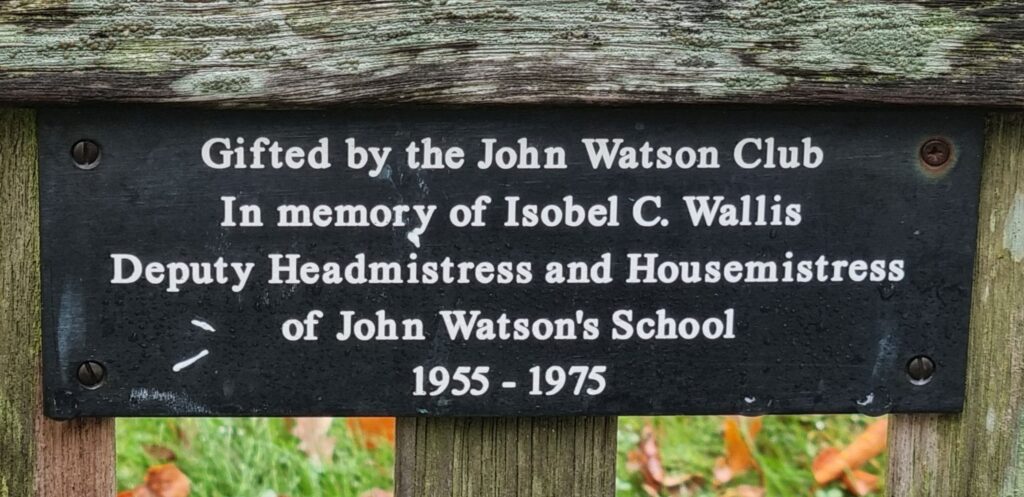
However, the many shorter and earlier accounts remain useful. The best of these is the School’s own account of itself, compiled from articles written for The Levite by D.M. Thomson and published in 1935. There are accounts of the School in both the 1890 and 1936 editions of The History of the Society of Writers to H.M. Signet and an interesting early paragraph written by John Britton and published in 1829 as part of Modern Athens, displayed in a series of views; or, Edinburgh in the nineteenth century accompanied by an illustration of the School by Thomas Hosmer Shepherd.
We have assembled these various accounts of the School here.
The Records
The records held by the WS Society are of three kinds.
Application forms compiled on behalf of successful intrants to the school. These are rich sources of societal data, setting out each child’s entire social circumstances and milieu. These are mapped onto a searchable database.
From these case studies have been selected for full digitization and discussion. 245 applications are present in the database, covering the year 1830-1840.
Administrative documents covering the setting up and opening of the School and its regular life thereafter. These have been mapped and summarised in a searchable database. 436 administrative documents are described in the database, covering the years 1822-1843 and 1861.
The Levite – the magazine of the John Watson’s Club, the organisation for the School’s former pupils. The WS Society own a run from the first issue of 1903 until the outbreak of the Great War, and further issues straddling 1939-1945. These have been digitized and are searchable.
Other Archives
The major collection of records of John Watson’s Institution is held by the City of Edinburgh Archives, with further important records held at and recently catalogued by the Erskine Stewart Melville Schools.
The portrait of Vans Hathorn
From 1838 until 1975 a portrait of the Father of John Watson’s Institution, Vans Hathorn WS, hung in the School Chapel. The portrait, by Sir Henry Raeburn’s greatest pupil Sir John Watson Gordon, disappeared from view for half a century after the School’s closure, but we are delighted to announce that it has been recovered and efforts are underway to return it to Edinburgh. You can read more about the portrait here.
The John Watson’s Institution Clock
The School clock, as familiar to former pupils as Van Hathorn’s portrait, is now in the care of the WS Society at the Signet Library in Edinburgh’s Parliament Square. The clock, dated 1829, is the work of the great Edinburgh horologist Robert Bryson (1778-1852), holder of the Royal Warrant and maker of a timepiece for the Calton Hill Observatory. Bryson was involved in the conversations that led to the founding of the School of Arts in Edinburgh, now Heriot Watt University. You can read more about the clock here.
The School Building
The John Watson’s Institution building, the work of the WS Society’s architect William Burn (1789-1870) is now in the possession of the National Galleries of Scotland as part of their Modern Art complex. Although the building was considerably remodelled during its conversion to an art gallery, we are grateful to gallery staff for drawing our attention to interesting survivals from the building’s days as a school. You can read more about the school building here.
The School Burial Ground
John Watson’s Institution owned its own burial ground, established for those children who tragically passed away whilst in the care of the School and whose own families were unable to provide them with an appropriate resting place. You can read more about the burial ground here.