
John Watson’s Institution Home
The story of the building of John Watson’s Institution is a complicated one, best told by Isobel C. Wallis in her canonical John Watson’s School: A History (Edinburgh: John Watson Club, 1982). What follows is a brief recital of the facts.
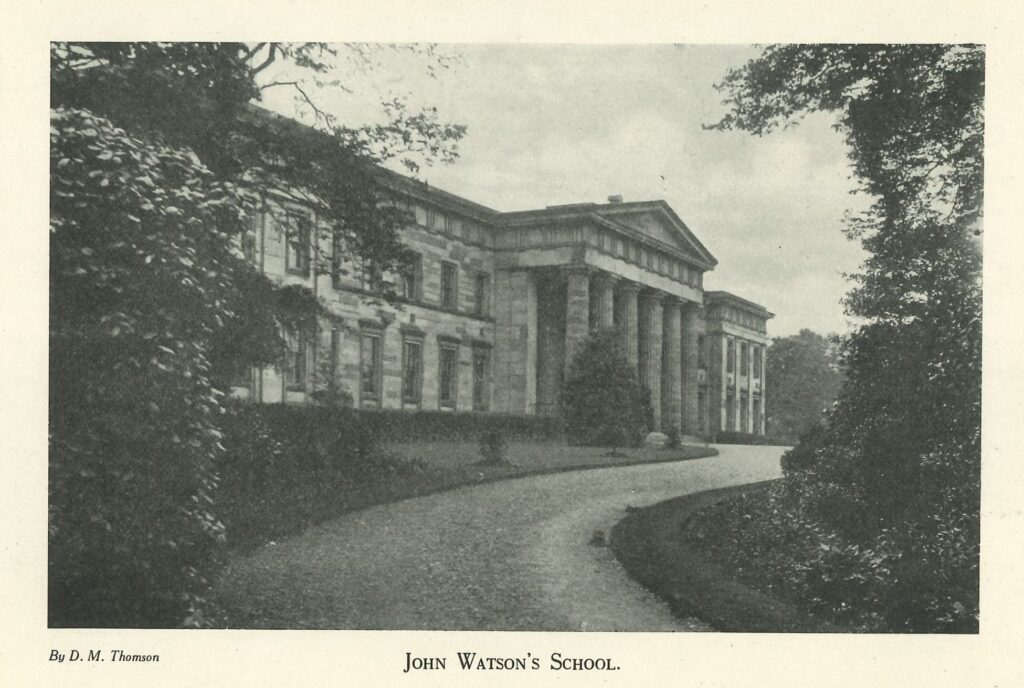
The School was constructed on land on the Dean Estate feued from Sir John Nisbet. The site stands high over the Water of Leith to the west of Edinburgh and enjoys fresh air and fine views to this day. The architect chosen to design the school was William Burn, who had been responsible for the Greek-frontaged Edinburgh Academy whose doors had opened for the first time in 1824.
The design for John Watson’s Institution took time to emerge. There were differences of opinion between the school’s directors as to the style best for the site, and Vans Hathorn as treasurer was keen to achieve both best value for money and a building that had a certain level of education in mind for its inmates. Burn would produce a number of different sets of designs to meet different requests, and at one point faced competition from a second architect who had been asked to offer an alternative. Some directors preferred a tower or spire rather than Burn’s Grecian portico.
The eventual design was both beautiful and rational, built around the smooth running of the school, with separate halves for boys and girls and a linking central chapel. The foundation stone was laid on 4th July 1825 with construction underway not long afterwards.
But problems dogged the building period. The original contractor, William Stuart Dinn, faced bankruptcy in 1827, and the project continued without him. Vans Hathorn won a stand-off with the replacement contractors over the contract and over expenses.
Finally, on 12th August 1828, in the presence of Vans Hathorn, the Institution – not entirely complete, its grounds not as clear or as beautiful as they would later become – accepted its first children.
For Burn, the story of John Watson’s Institution would never quite be over. A couple of years after Vans Hathorn’s death in 1839, Burn faced complaints from the directors that dry rot had taken root in the building and that its safety was endangered. Some of the correspondence from this row is preserved in the WS Society archives and can be reviewed in the project database of administrative documents.