
exhibition home page
Sir Francis Grant WS KCVO is a central figure in WS Society history as the compiler of the register of members for both the 1890 and 1936 – but his extraordinary and colourful contribution to Scottish traditional and intellectual life extended far beyond the walls of the Signet Library. He was a remarkably prolific author, writing over sixty genealogical works, including the seminal Manual of Heraldry which was first published in 1904 and which remains in print today.
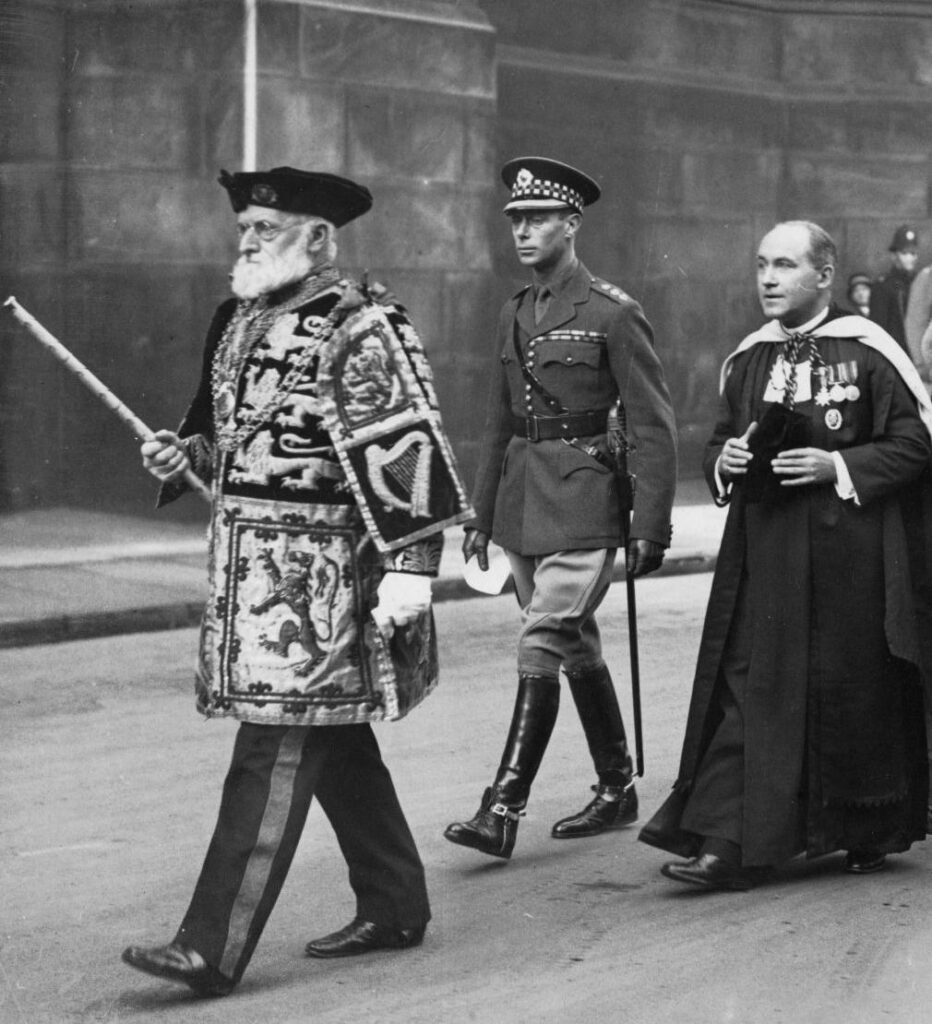
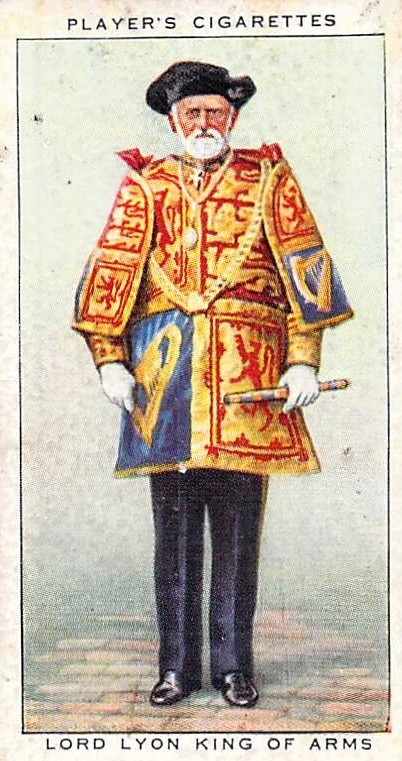
Born in 1863, He was the son of James Grant, Marchmont Herald, and would follow his father into the Lyon Court, becoming Carrick Pursuivant in 1886 a year before taking his oath as a Writer to the Signet. In 1898 he became Rothesay Herald and Lyon Clerk and Keeper of the Records in the Court of Lord Lyon. In 1925 he was made Convener of the Benefice Register and Church Records Committee and General Trustee of the Church of Scotland, and four years later King George V appointed him Lord Lyon King of Arms and Secretary to the Order of the Thistle. Always a distinctive figure, it is in his uniform as Lord Lyon that he is now chiefly remembered, and it is in this role that he – rather incredibly – became numbered among those WS to have been commemorated with a cigaratte card, or, in Grant’s case, several different cards from competing brands. The role of Lord Lyon is more than just a colourful ceremonial one: the Lyon Court is one of the key historical repositories, and the Lord Lyon themselves are one of Scotland’s key representatives and ambassadors.
The richness of the Scottish history landscape is owed of course to the writers and teachers of history, but there is another essential group who have played an enormous role in the mapping and preservation of Scotland’s history. This group is comprised of the editors, facilitators and contributors to an extraordinary series of Scottish intellectual societies. The first of these in WS Society terms was librarian David Laing, who was the heart and soul of the pioneering Bannatyne Society in the first half of the nineteenth century and the saviour of the Society of Antiquaries of Scotland in the second. Sir Francis Grant was a figure of similar stature, at various points in his life serving as chairman of the Scottish Record Society, the treasurer of the Scottish Text Society, and vice-president of the Society of Antiquaries of Scotland. He was a major contributor of research to all three, and the texts preserved by the SRS and STS in particular remain in heavy use today.
Grant was also joint editor of a new edition of Fasti Ecclesiae Scoticanae, the multi-volume biographical dictionary of Church of Scotland ministers. This is still in use today, which because of the uniquely central role of the Church in the story of the nation is an essential tool to any proper understanding of Scotland. The editorship was and is a formidable task: the first century of the post-1560 reformed church (and especially the years following 1689) saw a bewildering array of ministers both legitimate and those claiming congregations on flimsier terms, sometimes poorly or unreliably recorded. All of that had, and has, to be teased out and rendered comprehensible to the widest possible intelligent church and lay audience. That this great intellectual achievement comes in part from within the WS Society should be a matter of pride and celebration.