
exhibition home page
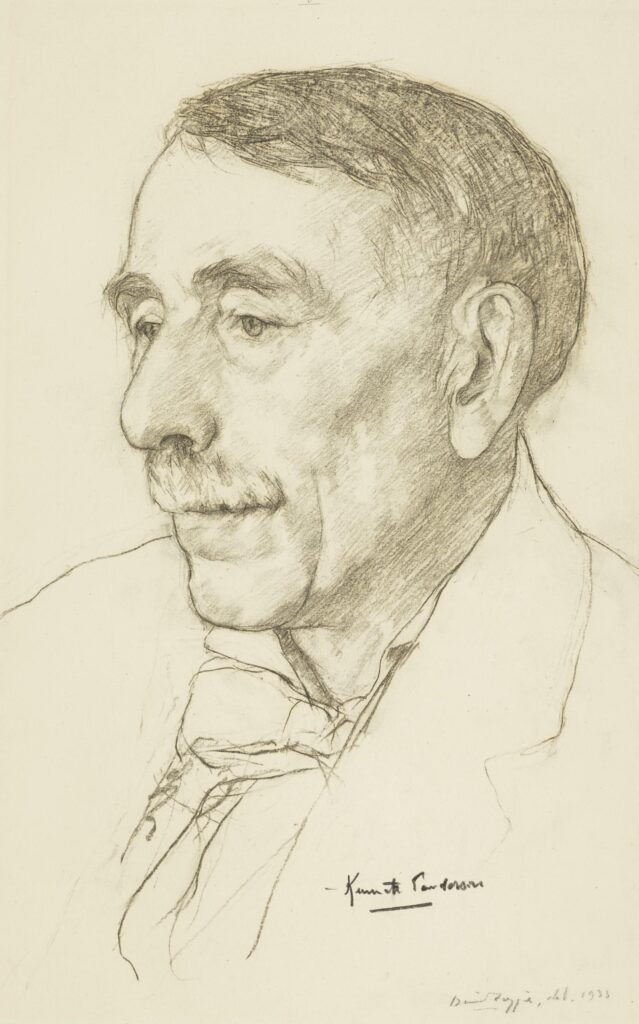
Kenneth Sanderson WS was not a national figure and unlike his WS contemporaries Leslie Balfour Melville and Sir Francis Grant his likeness never appeared on cigarette cards. But he was the Renaissance man of WS Society in the first half of the twentieth century, and at his death in 1943 left enduring contributions to the arts, to sport and to industry that can still be felt today. At different times in his life he was described as “ranked with Scotland’s best,” “the all-conquering Kenneth,” “passionately and purposefully attached to his own country’s traditions,” and “before everything the Scots lawyer, very alive in the service of his clients what highly discreet hints he let drop about his professional experience might have made a nucleus for a serious but highly readable guide to living”.
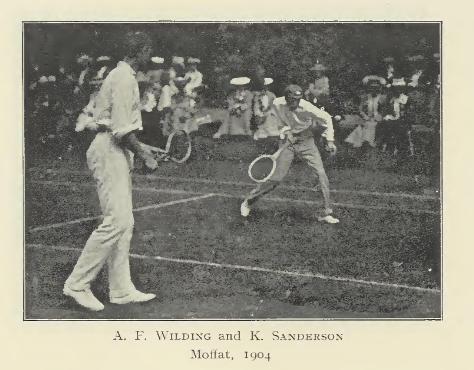
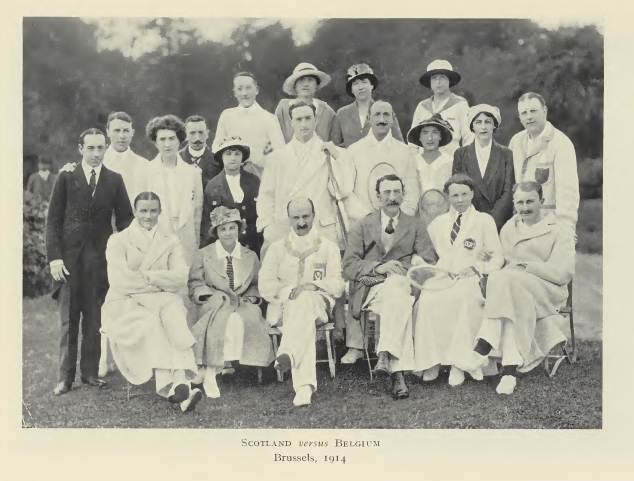
The subject of these comments was born in 1868 and by the age of 18 was one of the brightest talents in Scottish tennis at the beginning of its late Victorian and Edwardian Golden Age. He took his oath as a Writer to the Signet in 1891 and from that point on the sheer variety and depth of his professional and social involvements is extraordinary. In his late thirties, he had sufficiently established himself to return to tennis, winning the Whitehouse Cup (the championship of southern Scotland) in 1907 and again in 1908. In 1914 he was part of the Scottish team that took part in the country’s first recognised international match against Belgium. In 1927, A. Wallace MacGregor wrote that “For a man with a purely defensive backhand, and no “kill” in overhead work, his record, considering that he dropped out for about a decade, is really wonderful…to effect such a “come-back” as he did, was a great feat”.
By that stage, Sanderson had become a major player in the Scottish art world. His own collection of prints, engravings and paintings at his Abercromby Place home was perhaps the greatest assembled within the WS since the death of James Gibson Craig. He was an acknowledged authority, writing and lecturing on the work of David Martin, Andrew Geddes and Allan Ramsay, and from 1936 he was a trustee of the National Galleries of Scotland (and their accounting officer). He was part of the committee that curated the great London exhibition of Scottish art in 1939. His commitment was not only to the art of the Scottish golden age, however: he was one of the main driving forces behind the creation of the Scottish Modern Arts Association, and was the organisation’s chair from 1941. The Scottish Gallery of Modern Art would eventually be planted in the ground that the Association had opened, although its own collection is now in the care of the Edinburgh City Arts Centre.
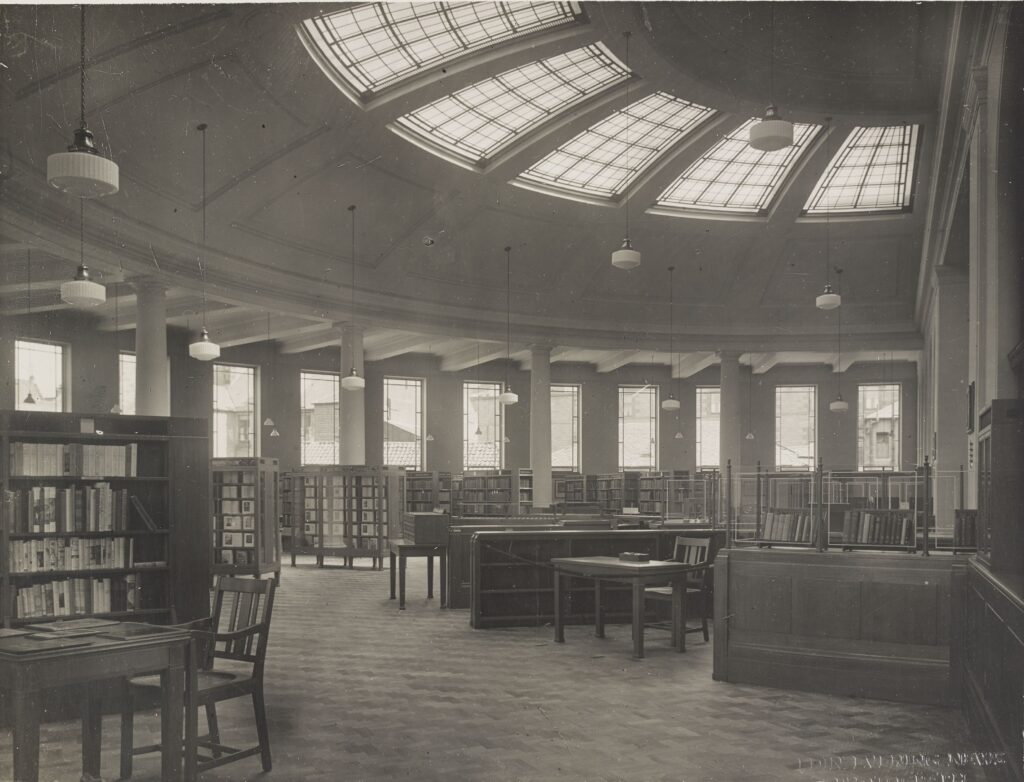
Sanderson was one of the major figures in the extraordinary growth of the Edinburgh City Libraries. He became chairman of the Library Committee in 1929, in a period when the service was led by the inspirational Ernest Savage, and when Savage was fighting to create Leith Library and Town Hall he could count on Sanderson to support and encourage him. What was achieved at Leith in the 1930s in terms of public education, the accessibility of knowledge and architectural design is obscured now: the complex never fully recovered from the terrible Leith bombing of 1941. But the libraries at Leith, at Fountainbridge and elsewhere were models of European and American practice, and mark a high point in the design of public building that has not been matched since. Sanderson was a curator of the Signet Library, and chair of the Library Committee of the University of Edinburgh, but he considered his work for the Edinburgh City Libraries as the chief accomplishment of his life.
Kenneth Sanderson had a long interest in the expansion of electricity provision and was a director of the Scottish Power Company that was the biggest player in the effort to extend supply across Scotland’s challenging territories. From beginnings in the central belt, by expansion, construction and takeovers of smaller concerns, by the end of Sanderson’s life it controlled over 5000 miles of power lines supplied by 15 power stations, including the first hydro-electric power stations in Scotland’s north.
His other involvements outwith his senior partnership at Wishart and Sanderson WS, taken on their own, were what many would consider a career in themselves. He was a founding member of the Sir Walter Scott Club and its first Honorary Secretary, a post he held for the next 27 years. He was a member of the Royal Burgess Golfing Society – and a fine player; he was also well-known in angling circles. He was an Elder of St. Cuthbert’s Church in Edinburgh, and Ordinary Manager of the Royal Public Dispensary in the city, which on its foundation in 1783 was the first free hospital in Scotland. From 1907, he was a council member of the Royal Scottish Geographical Society.
His friends in the south are likely to remember most vividly the hospitality of his house in Edinburgh, where his natural sense of style in quiet but ordered living, his active and lean but slightly shaggy presence and the quality of his Doric speech all gave witness to his warmth of heart.
Kenneth Sanderson WS died on 16th October 1943 at the age of 75. His obituary in The Burlington Magazine was glowing: “His friends in the south are likely to remember most vividly the hospitality of his house in Edinburgh, where his natural sense of style in quiet but ordered living, his active and lean but slightly shaggy presence and the quality of his Doric speech all gave witness to his warmth of heart”. His collections were granted to the institutions he had so faithfully served, with 800 prints and three paintings being bequeathed to the National Gallery, his books to the Edinburgh Public Library and a collection of early Raeburn and other engravings to the Signet Library.