
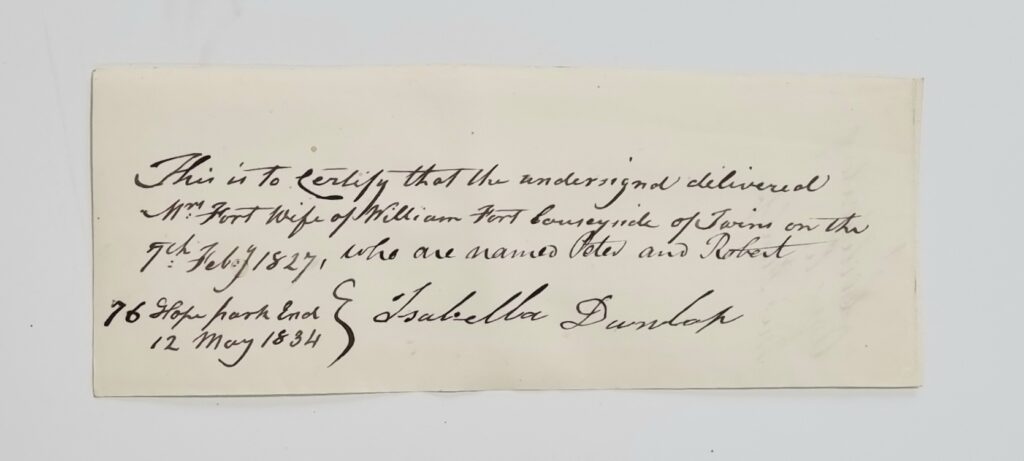
Peter Fort was born on 7 February 1827. His father William Fort, a grocer, died insolvent in December 1833 leaving his wife Elizabeth Lieshman Fort a widow with fourteen children, four of whom, Maria, James, and twins Robert and Peter were under the age of ten. Elizabeth tried to carry on her husband’s business, but her husband’s debts left her unable to re-stock the grocery shop.
Some of Peter’s siblings worked to support the family when they could. Ann had to leave service due to lameness and Isabella was an unpaid servant seeking a place with pay. David was an apprentice shoemaker and William an apprentice tailor; neither of them made enough to help the family. Edward, Lewis, Maria, James, Robert, and Peter all relied on their mother as dependents.
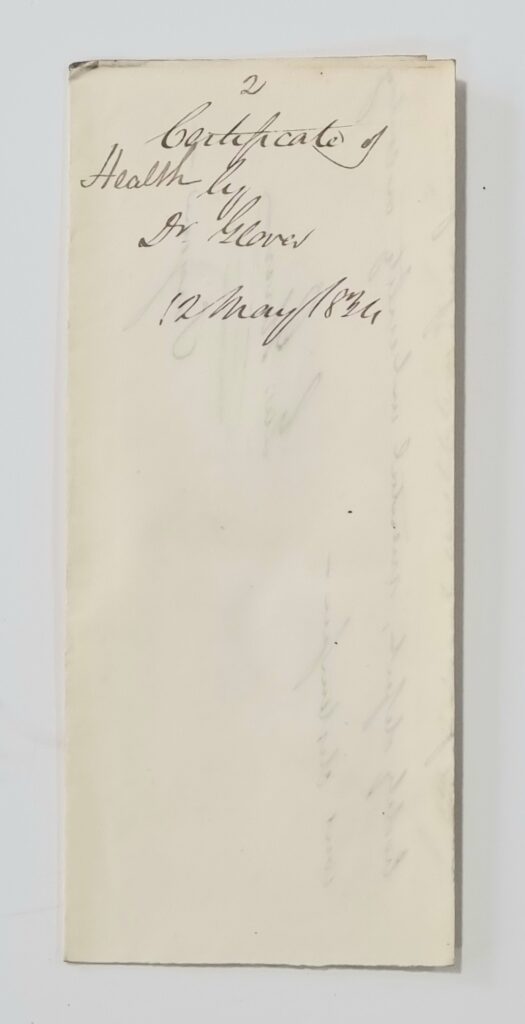
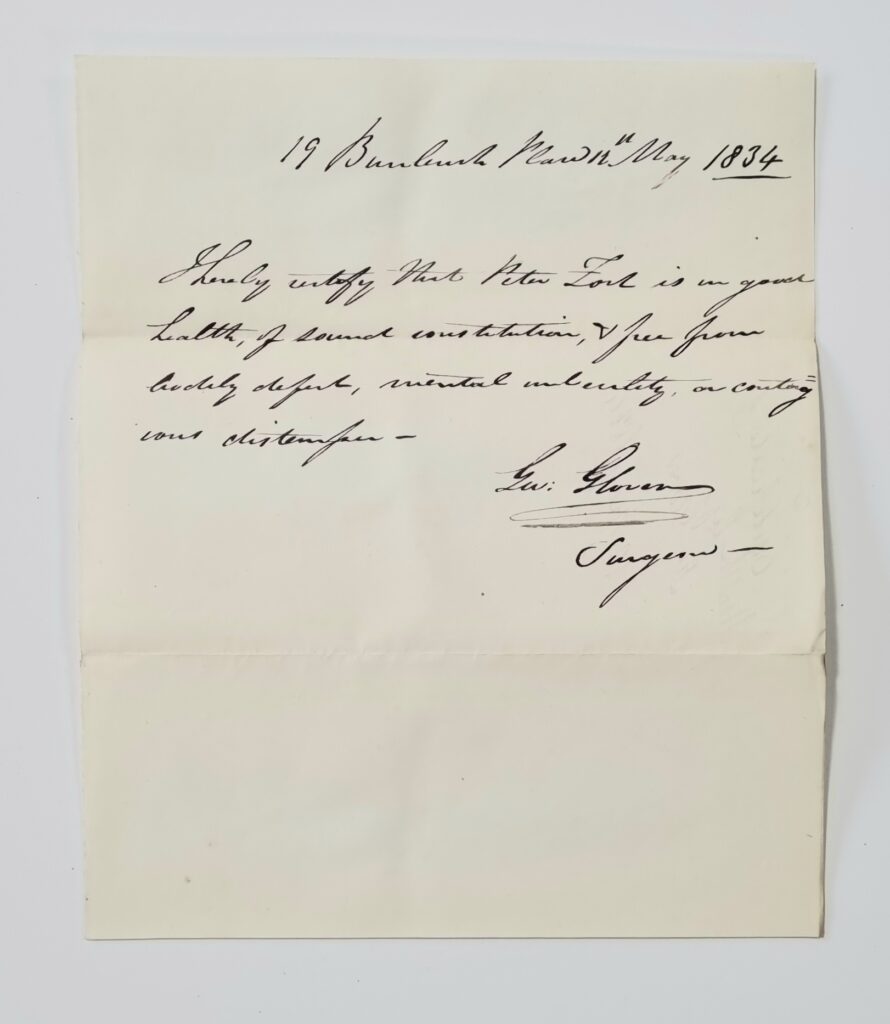
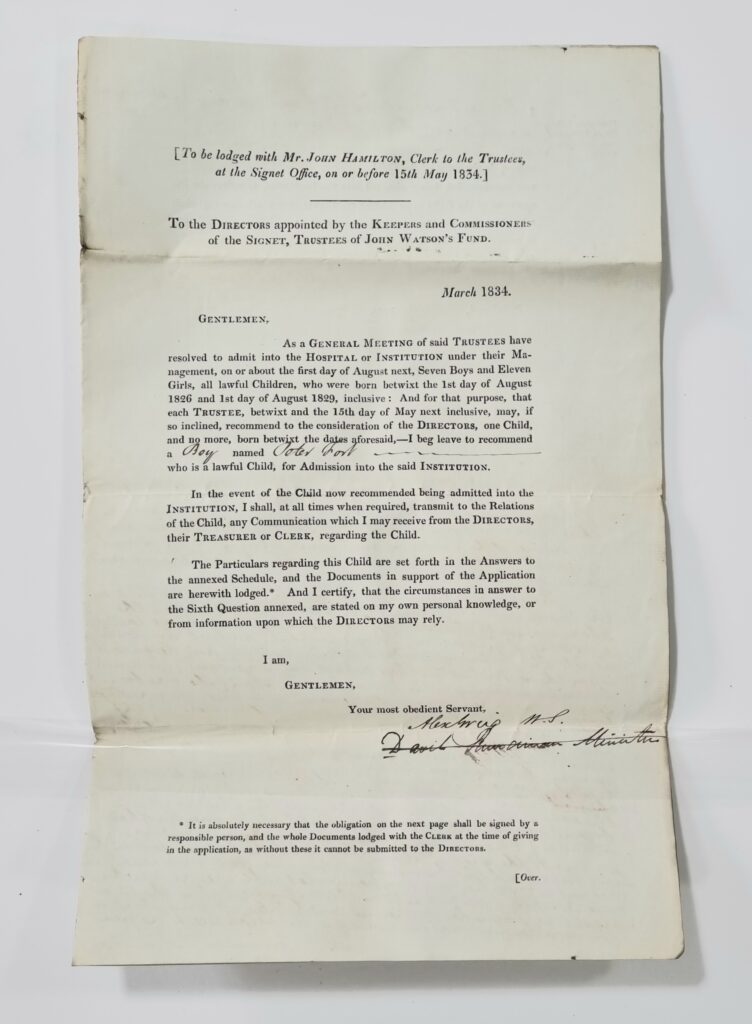
Peter’s application was supported by his certificate of health and his certificate of birth, along with his twin brother Robert, signed by midwife Isabella Dunlop. He was admitted to John Watson’s Institution in 1834.
Peter married Jean Shearer on 22 May 1847. He was residing in the Parish of Falkirk; she in the Parish of Kilmadock.
The 1851 Census finds Peter as a lodger in Denny and working as a house painter; Jean is not listed with him.
Peter was married to Agnes Bryce by 1853 when their daughter Catherine was born. Their son James was born in Greenock on 20 August 1855. Catherine died at Dalkeith on 14 March 1856. A son Louis was born on 8 July 1857 in Dalkeith. Their daughter Margaret was born in Greenock on 19 October 1866.
Peter does not appear in the Scottish Census returns for 1861. He was a lodger in the parish of Caddenfoot and working as a painter in 1871.
The 1881 Census finds Peter as head of a household at 7 Viewforth Park, Edinburgh with his wife Agnes and daughter Margaret (14), a vulcanite worker, and working as a house painter.
Peter died on 4 May 1881 with his cause of death listed as ‘Cut Throat (Supposed Suicide)’. His son-in-law Andrew Lane of Glencorse Barracks identified him. A corrected register entry notes that his cause of death was ‘not certified by a medical man’.
Peter’s death was reported in the Peeblesshire Advertiser on 7 May 1881:
Suicide. – On Wednesday morning, about five o’clock, a shepherd discovered the body of a man near the ‘high’ road between Edinburgh and Carlops at a place named Soutersyke [Salter’s Syke], about two miles from this. The unfortunate man has his throat cut, the left hand grasping a razor. Nothing was found on him to establish his identity. A ‘putty’ knife and a pair of overalls in his pocket suggested that he was a painter or glazier, and he had what was apparently his dinner in his pocket, and the leaves of a diary for Wednesday and the following three days, it appeared as if he had been going to some country house to work. Deceased was about forty-five or fifty years of age, was dressed in a dark tweed coat and vest, with light trousers and a black felt hat. The body has since been identified as that of Peter Fort, a painter, residing in Edinburgh. He had been out of regular employment for six months, but is understood to have been jobbing in the country lately. His state of mind, however, for some time back has been such as to cause his friends considerable anxiety. He leaves a widow, and with a single exception, a grown up-family. The body was removed to Edinburgh for internment Thursday evening.
The Southern Reporter reported on 12 May 1881:
Suicide near Penicuik. – On Wednesday morning, about five o’clock, a shepherd discovered the body of a man near the ‘high’ road between Edinburgh and Carlops at a place named Soutersyke, about two miles from Penicuik. The unfortunate man had his through cut, the left hand grasping a razor. On Thursday the body was identified as that of Peter Fort, a painter, who resided at 7 Viewfield Park, Edinburgh. He was between forty-five and fifty years of age.
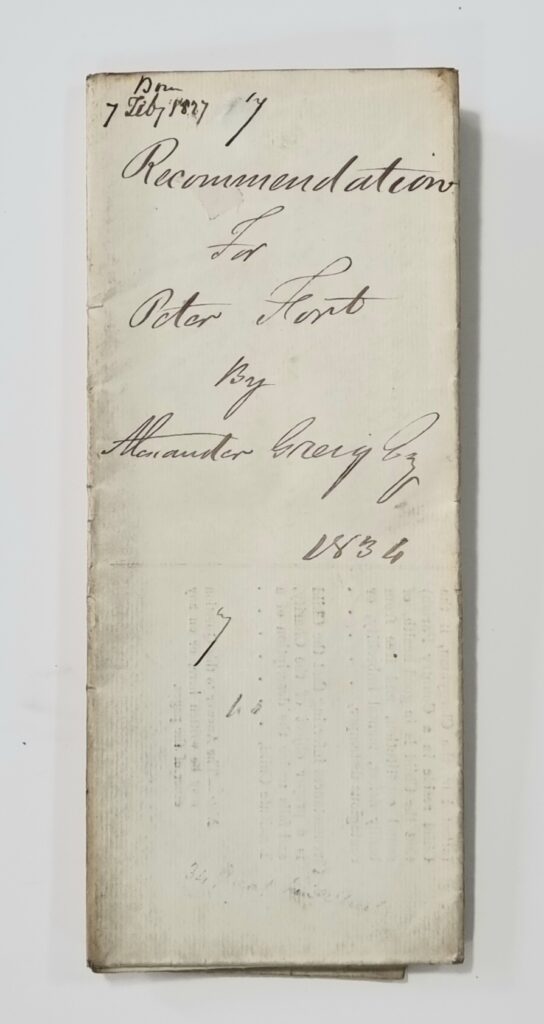
application
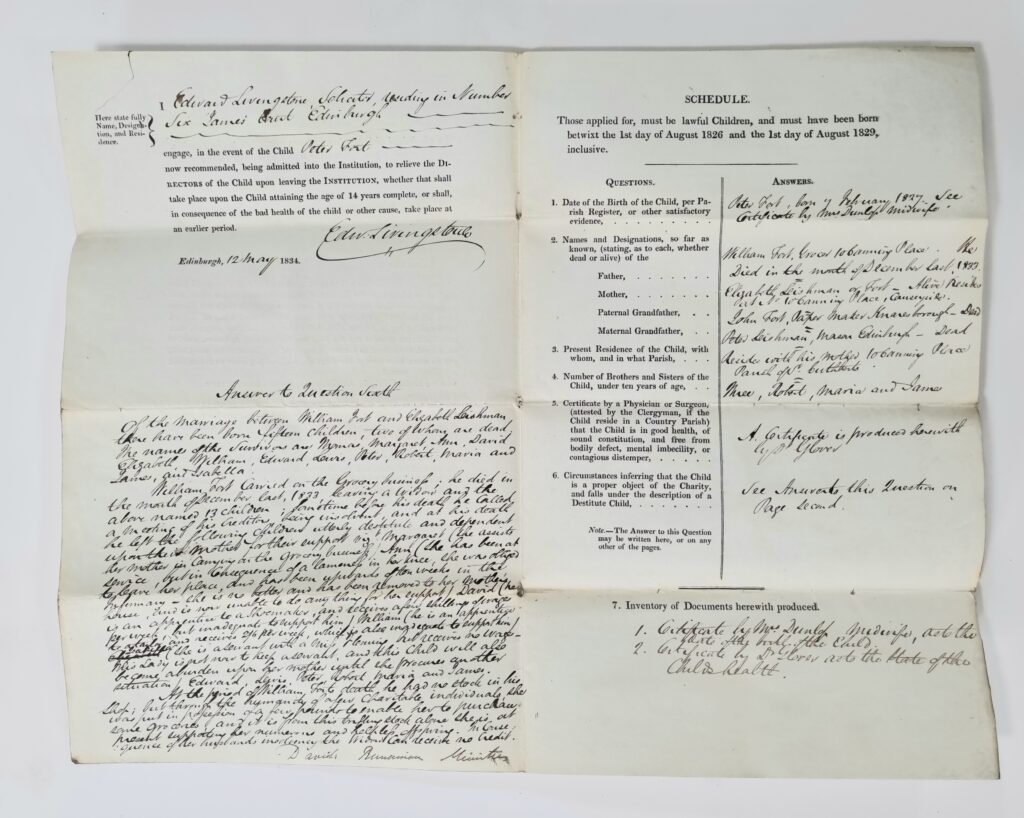
Certificate of Age
Certificate of health