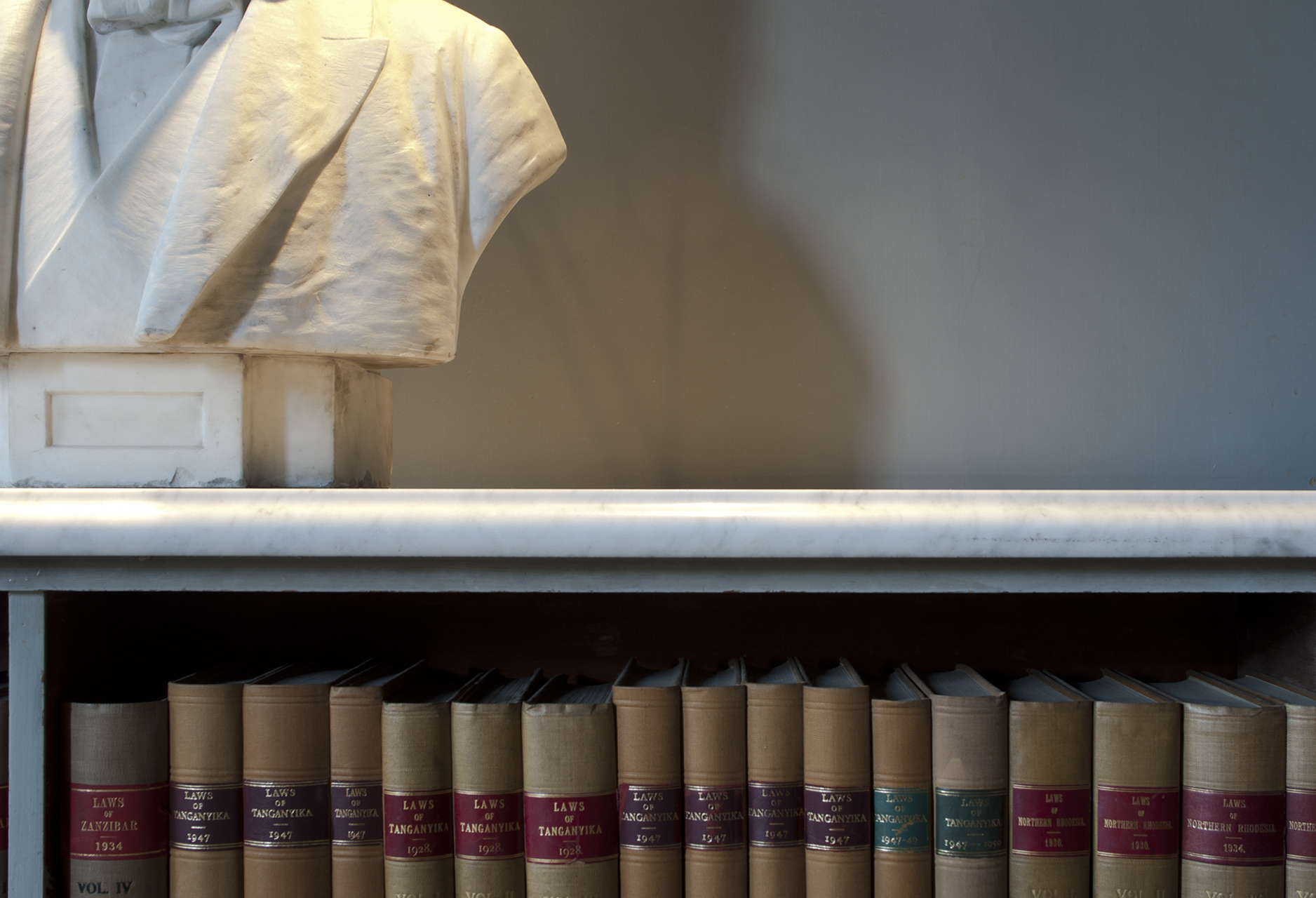

exhibition home page
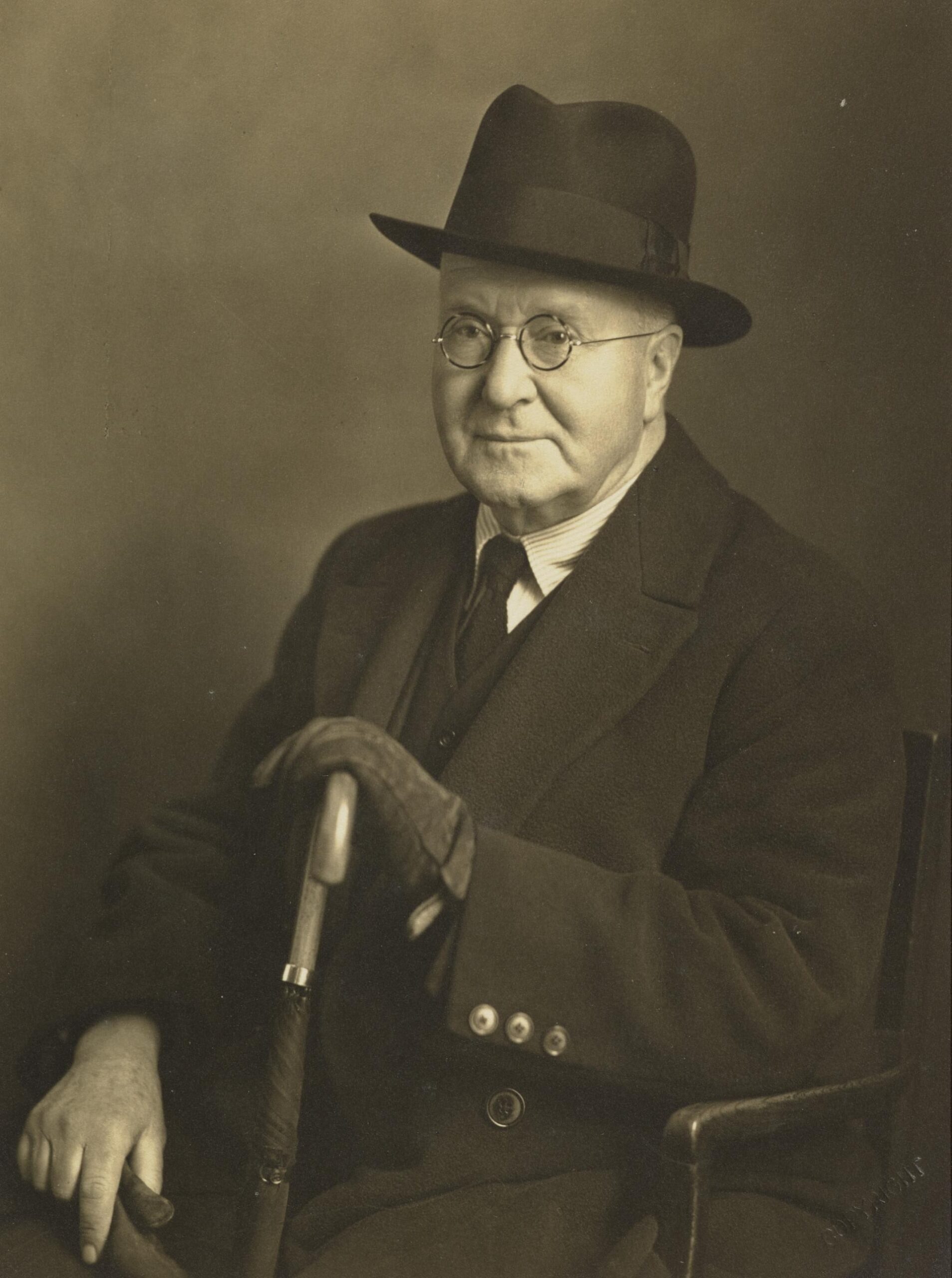
end of his life by Edward Drummond.
This article was written by Anna Bennett WS in 2012 and featured in a special issue of Signet Magazine commemorating the 60th anniversary of the donation of the Roughead Collection to the Signet Library. The two that follow are edited from those written by Dr. Kit Baston for the same commemoration.
The Commissioners’ Room in the Signet Library has an atmosphere all of its own. Its oak lined bookcases, open fireplace and view over the illuminated desks in the Advocates’ Library create a special sense of Scottish legal heritage. But it is the unique collection of books on the Commissioners’ Room shelves, donated by the late William Roughead WS, which weaves the most fascinating of personal histories. The WS Society’s “Roughead Collection” has international importance, for Roughead was a pioneer of modern crime literature, recognised across the world. May 2012 marks the 60th anniversary of his death.
Roughead’s entrance to the legal professional was quite traditional. After early studies at Edinburgh University he was an apprentice to T.S. Maclaren and William Traquair. He was admitted as a WS in July 1893.
That same year Roughead used family inheritance (his father owned an outfitter and draper’s shop on Princes Street) to set himself up as a lawyer in premises at 122 George Street, Edinburgh. Roughead’s independent wealth was pivotal to his future. Without the pressures of looking after clients and seeking out new work, he was able to devote his time to his true interest. Roughead was afforded the opportunity to begin on a new path, as a writer and editor of studies in crime.
There were early signs of this alternative career in 1889, when, at the age of 19, he skipped apprentice duties to attend the trial of Jessie King, the “baby farmer” of Stockbridge. For the next 60 years Roughead attended almost every murder trial of significance at the High Court of Justiciary. Essays by Roughead on these experiences were first published in the Juridical Review.
The essays and commentaries quickly evolved into wider studies of crime, which were printed in overlapping anthologies, each including the word “murder” in their title. In fact, Roughead regretted not using this reference in the title to his first book, which he simply called Twelve Scots Trials. He later expressed his disappointment:
I have always considered that my venture suffered in its baptism… of those three fateful words two at least were unhappily chosen. ‘Scots’ tended to arouse hereditary prejudice… ‘Trials’ suggested to the lay mind either the bloomless technicalities of law reports or the raw and ribald obscenities of the baser press… Had there been a ‘baker’s dozen’ the game would have been up indeed.
A lifetime’s work in literature followed, which gained Roughead the accolade of “recording angel of Scottish matters criminous”. His skill lay in his ability to convey the content of the criminal mind to the reader. His accounts of the dark and sinister intentions of the accused, who by all other appearances were ordinary people, represented a new way of commenting on murder and crime.
Roughead edited nine volumes in the Notable Scottish Trials series. His books allowed the entire case to be put before the reader, resulting in a feeling of being present in the courtroom as the proceedings took place. Roughead enjoyed a special relationship with court officials and staff. He had his own reserved place and desk in the High Court and consulted official records freely. His writing was thorough and detailed, but his were not books for lawyers, they were for everyone.
Roughead’s editions in the Notable Trials series included accounts of some of the most notorious criminal cases both old and new, including such household names as The Trial of Burke and Hare (1828), The Trial of Captain Porteous (1736) and The Trial of Deacon Brodie (1788). However, it is widely accepted that his greatest achievement was his analysis of the trial of Oscar Slater and his integral part in the appeal process, the topic of a separate article in this magazine.
Although his work always concerned crimes committed in Scotland, his appeal was much wider, crossing nations and continents. He had popular success in the US, where the American audience relished his dry sense of humour and inimitable style. President Franklin D Roosevelt kept a complete set of Roughead books in his personal collection, on a shelf outside the Oval Office. American culture was embracing pulp fiction, the new style of the detective novels by Raymond Chandler, Dashiell Hammett and James M Cain. Film noir was emerging and Roughead’s dramatic and engrossing accounts of pre-meditated crime fitted in well.
Roughead gained praise from his contemporaries and peers. His friend Henry James talked of his “witty scepticism, and a flair for old-fashioned storytelling and moralising” whilst Dorothy Sayers described him as “the best showman who ever stood before the door of the chamber of horrors”.
These comments perhaps do not portray the man behind the writing. He was described as “kindly”, even “cherubic” in an article which appears in the Sunday Post in December 1939. He had a retiring disposition and was sensitive to any reference to his baldness (pictured with a hat and glasses most often). In the Sunday Post interview he admitted:
I have a pretty soft heart and time and time again, when the judge has put on the black cap and the condemned man or woman has howled in terror, I have felt almost sick. I have sworn at these times I had never attend another trial. But well, something draws me back.
It is this human response coupled with his critical legal ability which makes Roughead’s writing so rich, influential and still relevant today.
William Roughead’s Friends
By Dr. Kit Baston
One of the most enjoyable aspects of working with William Roughead’s library (bequethed to the Signet Library after his death) is finding the treasures tucked inside Roughead’s books. Roughead kept an assortment of correspondence and photographs in his books. The inscriptions, letters, and postcards are addressed to Roughead from the authors of the books and they often give him credit for inspiring their authors.
Roughead was not alone in his pursuit of crime and exploration of criminology. His work inspired other writers to explore the dark side of human nature. Roughead was generous with his materials and insights and he often lent books and provided feedback for his fellow criminologists. As evidence from his library of crime books shows, Roughead’s network of correspondents included Edward Pearson, Horace Bleackley, H. B. Irving, and Sir Arthur Conan Doyle.
Edward Pearson
Edward Pearson (1880-1937) was a Librarian of Congress and, like Roughead, a true crime pioneer. Pearson wrote to Roughead in 1923 -the letter is in Studies in Black or Red (Roughead Collection, R340.9 P31) – to thank him for book recommendations and to announce his “plan to tread somewhat in your footsteps that is, one on American murder trials. Since a celebrated double murder in Massachusetts when I was a schoolboy, twenty-five years ago, the subject has always fascinated me, and your books have tempted me to try the same field”. Pearson’s best known work, Studies in Murder, was published in 1924 and featured an essay on the axe murderer Lizzie Borden – the celebrated double murder case that had caught his attention when he was a boy – which Roughead greatly admired. The two authors were firm friends and Pearson visited Roughead during his visits to Scotland. Roughead’s copy of Pearson’s edition of The Autobiography of a Criminal (by Henry Tufts) contains the inscription: “For: William Roughead, from his friend, admirer, and assistant toiler in the same vineyard. Edmund Pearson. March, 1930”.
Horace Bleakley
The historian and criminologist Horace Bleackley (1868-1931) did research on Roughead’s behalf. Roughead’s copy of his Some Distinguished Victims of the Scaffold (Roughead Collection, R343.9 B61) is bound with a letter containing notes from the British Library. Another letter in the same book is from Bleackley’s son who introduces himself and hopes to meet his father’s friend on his next visit to London. Roughead acquired of Bleackley’s antiquarian books after his death including three pamphlets dated 1752 about the trial and execution of Elizabeth Jeffryes and John Swann for murder (Roughead Collection, R343.1 J388(1-3)).
H.B. Irving
Another of Roughead’s correspondents, H. B. Irving (1870-1919) was the son of the famous Victorian actor, Henry Irving. The younger Irving also acted before turning to criminology and writing. Roughead’s copy of his Studies of French Criminals of the Nineteenth Century (Roughead Collection, R343.9 Ir8) contains not only a letter from Irving to Roughead dated 31 July 1912 but also a photographic postcard featuring “Mr. H. B. Irving as Dr. Jekyll” which shows that he retained his taste for the theatrical. Roughead gave books as gifts as well as receiving them. His copy of Irving’s Last Studies in Criminology (Roughead Collection, R343.9 Ir8) has a letter from Irving thanking him for the gift of a book.
Arthur Conan Doyle
The best known of Roughead’s friends today is Sir Arthur Conan Doyle (1859-1930). The two worked together to put the famous Oscar Slater miscarriage of justice right. Conan Doyle introduced Roughead to the journalist William Park when he was investigating the Slater case. Roughead’s copy of Park’s The Truth about Oscar Slater (with the prisoner’s own story) (Roughead Collection, R343.1 S115) contains letters from both Conan Doyle and Park and the inscription “To W Roughead from A Conan Doyle with best regards July 31st 27”.
Roughead did not only keep messages from the authors of his books: he also kept correspondence with their subjects. His copy of John Buchan’s biography of Andrew Jameson, Lord Ardwall (Roughead Collection, R340.92 B85) contains a letter dated 19th July 1909 from Jameson to Roughead which thanks him for his gift of his book on the Deacon Brodie trial and his loan of his Introduction to the Porteous Trial.
Roughead was acknowledged as a leader in criminological studies by the editor of The Black Maria, ог, The Criminals’ Omnibus (Roughead Collection, R 343.9 H66) who inscribed the work: “To William Roughead one of the first drivers of the Black Maria from Henry Hodge, Sept. 1935” when it was published. The work included Roughead’s study of the Mary Blandy murder trial of 1752.
Roughead’s influence on the development of the true crime genre is profound. The letters and inscriptions in his books reveal an international network of true crime pioneers who followed Roughead’s example and who relied on his friendship and support.
William Roughead: Poet
By Dr. Kit Baston
A small volume of poetry is shelved near the Roughead Collection in the Signet Library’s Commissioners’ Room. Alongside studies of criminal acts, executions, and the dark side of human character, written and collected by William Roughead WS, there can be found poems with such gentle titles as Seaside Regrets, The Coming of Christmas, and To Celia, Cycling. The poet is none other than William Roughead.
According to the Oxford Dictionary of National Biography, Roughead published this selection of poetry for the amusement of his friends in 1901. The poems are not works of great seriousness and, given that he published them a year after his marriage to Janey Thomson More, it is likely that the publication was a celebration of love and friendship rather than any attempt to establish a reputation as a poet. Roughead had set up his legal practice in 1893 but had never attracted many clients, nor did he need to thanks to his inheritance. Although he regularly attended trials at the High Court of Justiciary from 1889, when he attended what he called his “first murder”, the case of the notorious “baby farmer” of Stockbridge, Jessie King, Roughead found time to compose verse. He became famous for his attendance at trials and for his skilled accounts of criminals and their deeds past and present, but Rhyme without Reason was his published first book.
Roughead’s foreword mentions that some of the verses had been published in periodicals and that some with “even less merit” were “rhymes of earlier date. Some of them indeed read like juvenilia, but others show a flair for language and the gift of description that made his reports of criminal deeds and trials so readable and popular.
Roughead’s verses have a variety of styles, settings, and voices. Lines to a Royal and Ancient Game celebrates the long history of “gowff and features the idea of King Jamie “In days o’ yore…” leaving behind his royal role to “blythely tae Leith Links repair Wi’ clanny cleck”. There is a mention of champagne in The Penny a-Line Wedding where press attempts to glamorise society marriages to sell weekly magazines mean that “Although there be but tepid tea and lemonade in siphons, The notices will hum with Pommery and Mumm”. In The Complaint Feminine, the girl narrator laments that her “naughty brother Jack” can get away with rudeness, destruction of toys, sliding down banisters, messing up his clothes, frightening the maid, and pinching their nurse. “I must confess I think it rough, That, in polite society, What for Jacks is right enough, In Jill is impropriety”, she muses.
“Society”, particularly that of Edinburgh, gets another critique from Roughead in East Wind and West End. For here “An outsider for years may endeavour, with tears, To break through its etiquette cliquey; If the money he’s made has a savour of trade, It will do him no good in Auld Reckic”. Edinburgh appears throughout the poems: the Usher Hall gets its own poem and the speaker in A Spring Lament admits that although he “wadna rin Auld Reekie doun, For weel I luve ma native toun… (No’ that I’m seekin’ tac complain), Gin we had but a wee less rain, Twad be a treat”.
Although most of his verses are light hearted, Roughead’s love of the gruesome is not far away. In The Disposal of the Inanimate, the murderous sexton Joe Shovel deals with a threat to his livelihood by killing a crematorium owner and burying him in a traditional grave. Roughead was a director of Warriston crematorium where he was himself cremated before his ashes were buried at Grange cemetery.
In The Wooing of Barbara, a jealous suitor poisons a “bumptious, bald, and blatant” brewer with his own beer. Alas for our narrator Barbara “- to win whose hand I’d made my own so gory-Rejected my proposal, and withdrew to Tobermory”. Roughead was fascinated by poisoners and he wrote about some of the most famous of them, including Mary Blandy and Dr Edward Pritchard, in his later literary offerings.
Roughead was part of a long and rich tradition of legal poetry in Scotland. Charles Areskine, Lord Tinwald (1680-1763) composed on his deathbed a Latin verse celebrating the end of the Seven Years’ War. James Boswell rhymed “assure us” with “Corpus Juris” in the mid-18th century. One Thornton Thistle offered a poetical study of the Bench in Edinburgh: A Poem in 1840. Charles Neaves, Lord Neaves (1800-1876), was as well known for his satirical poetry as for his judgments on the Bench. Sir Walter Scott was, of course, internationally famous as a poet before he turned to writing novels.
Roughead had collections of legal verse in his library. The Roughead Collection includes The Court of Session Garland (Edinburgh, 1839) and Ballads of the Bench and Bar, or, Idle Lays of the Parliament House (Edinburgh, 1882). It is difficult to determine Roughead’s real feelings about the merits of his collected poems. His “Ars Poetica” puts the practice of composition in the context of a family home where “you start at the smash of the crockery’s crash”, “your wife, in a fume, rushes into a room”, and “there’s always a draught where you’re plying your craft” as “you sit yourself down with a resolute frown, On your marble-like, classical forehead”.
One poem in Roughead’s book has particular relevance as we celebrate the sixtieth anniversary of the arrival of Roughead’s criminology collection at the Signet Library. In To My Books, a more serious poem than most in his collection, Roughead describes his books as his closest friends. It seems appropriate to reprint his own tribute to his library.
“To My Books” By William Roughead WS (1870-1952)
If faithful friends he hard to find,
And harder still to keep when found.
Then am 1 blessed among my kind,
For those I have a safely bound;
Fast friends, with never failing tact,
Responsive to my changing mood,
Yielding what service I exact,
Regardless of ingratitude;
Come health or sickness, joy or ill
A zest or solace for my need,
And ever willing to fulfil
The mission of a friend indeed.
In seemly show of ordered rows,
You rise around me as I write,
While every volume of you knows,
My care to have you clean and bright;
Comented that no Vandal hand,
Shall make your ‘choice condition’ less,
No desecrating finger brand,
Your margin’s uncut comeliness
That while I live to call you mine,
You sit secure upon my shelves,
And confidences we confine,
As friends, entirely to ourselves.