
WS Society online exhibition 2026 – exhibition home
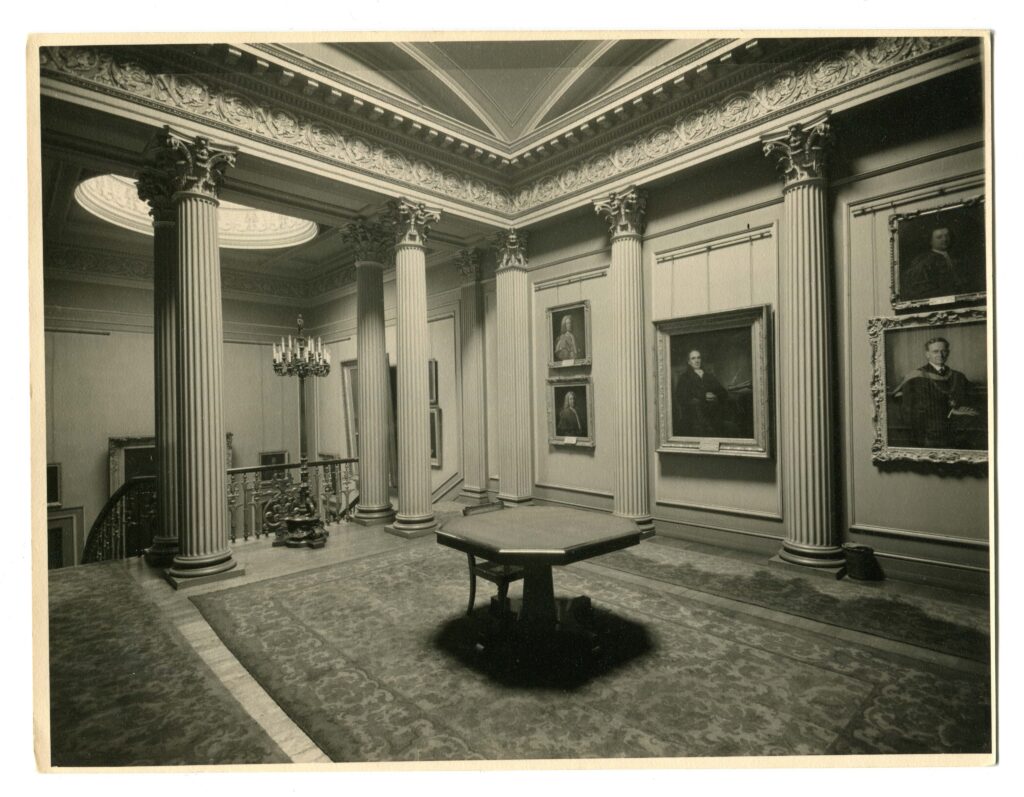
By the end of 1850, the ceremonial approaches to the Upper Hall – the Grand Staircase and Playfair Lobby – constituted the greatest legal picture gallery in Scotland. Indeed, with the Upper Library then open to visitors every weekday morning, this remarkable ensemble of spaces had for much of this period been one of only a handful of sites in Edinburgh to offer public access to art of any kind. This was the result of an intense period of WS Society acquisition and especially commissioning of art in the period between 1833 and 1838, but it has its origins forty years earlier in the Signet Office in the WS Society’s first home in Writers’ Court.
Sir Henry Raeburn and the first WS Society art
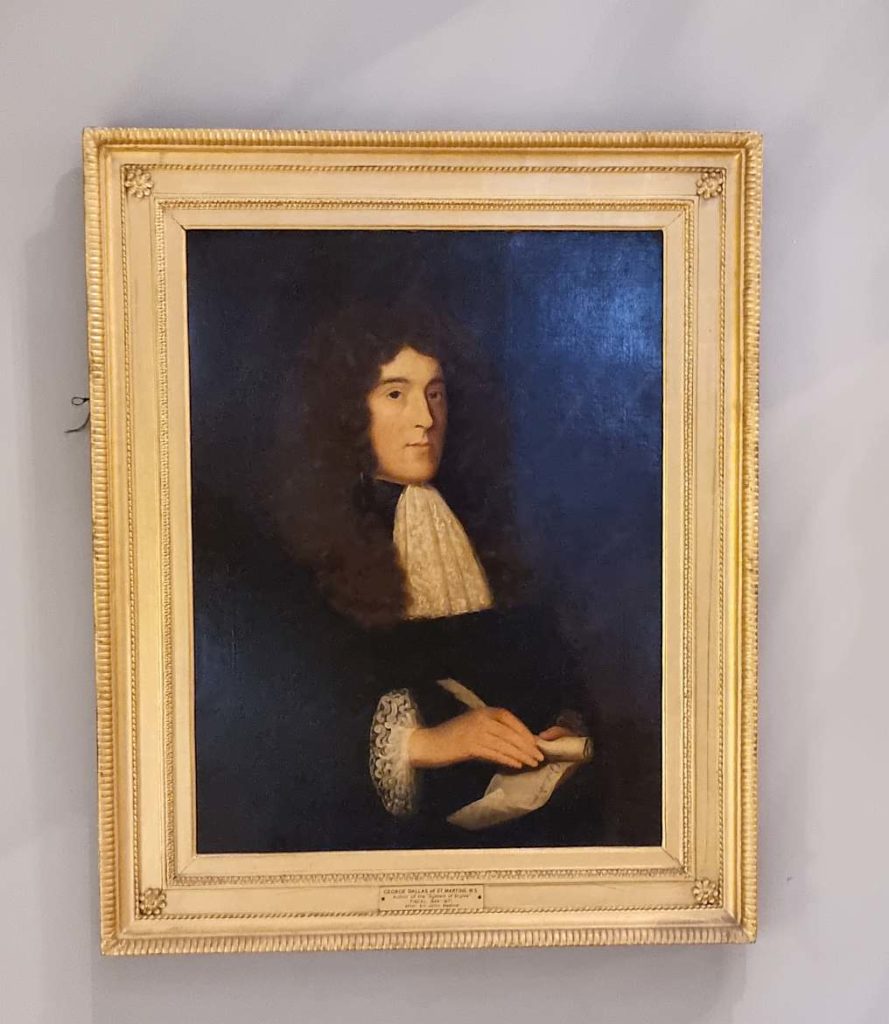
The first picture known to hang on WS Society walls was David Scougall’s 1660 portrait of George Dallas of St. Martin’s, which had been painted to mark both the Restoration of King Charles II and his own marriage. Dallas would take his oath as a Writer to the Signet the following year and in 1697 he presented the Society with a copy of his book, the epochal Sistem of Styles. This painting is now lost, last known sold at the Weedingshall sale of 1845.
The picture, lent to the Society by William Dallas WS, had been hung in the Signet Office for an unknown period when on 8th February 1790 the decision was taken that would mark the true beginnings of the WS Society’s magnificent inheritance of art:
The Keeper informed the meeting that Mr. William Dallas one of their brethren great grandson of Geo. Dallas of St Martins author of the System of Styles was in possession of an Original Portrait of his great grandfather & had been so obliging as lend it to the Signet Office, where it now is. That Mr. Dallas had agreed to allow a Copy of it to be taken and he proposed to the meeting that a copy of said portrait should be taken & hung up in the Hall – The meeting unanimously approved of the Proposall & requested the Keeper to Employ some proper artist to make the copy & to Return the Thanks of the Society to Mr. Dallas for his permission so to do & for the use of the Original.
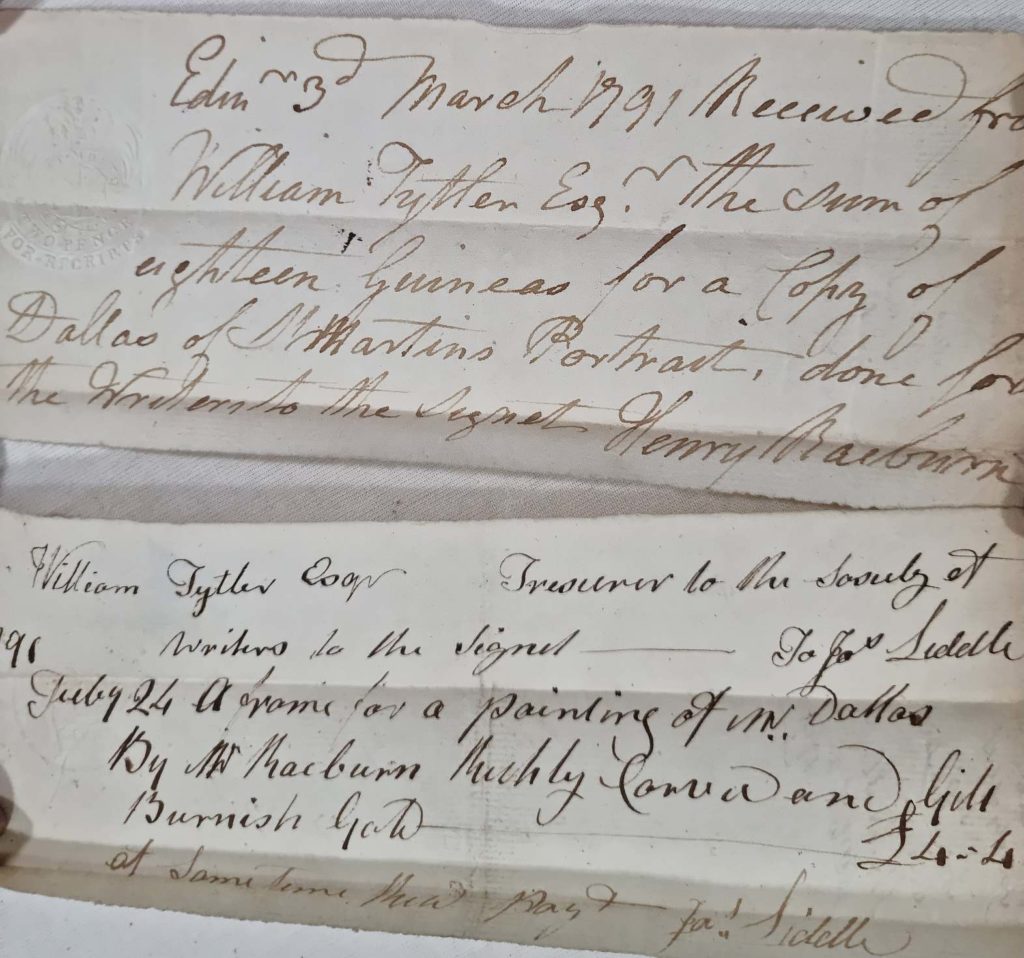
The receipt recording the payment to the artist for the copy is dated 3rd March 1791. Eighteen guineas were paid on behalf of the Society by the lawyer and historian William Tytler of Woodhouselee, then the Treasurer of the Society. Tytler was one of the Fathers of the Signet Library, and hugely significant in its history, but his august presence is outshone by the signature on the receipt, which is that of (Sir) Henry Raeburn, the greatest portrait painter in Scotland of the late Enlightenment. Although it is likely that the copy was made at Raeburn’s studio by apprentices, there is at least some possibility of the copy involving the hand and brush of Raeburn himself, who was still developing his style and his practice alike at this stage of his life and was not yet the preeminent artist that he would later become.
The second receipt, dated 24th July 1791, relates the provision of the portrait’s “richly carved, gilt burnished gold” frame for £4-4s by James Liddle (who Williamson’s Directory finds in Teviot Row (now part of Lauriston Place). At that time, Liddle was Raeburn’s framer of choice.
Henry Raeburn would remain the Society’s artist of choice until his death.
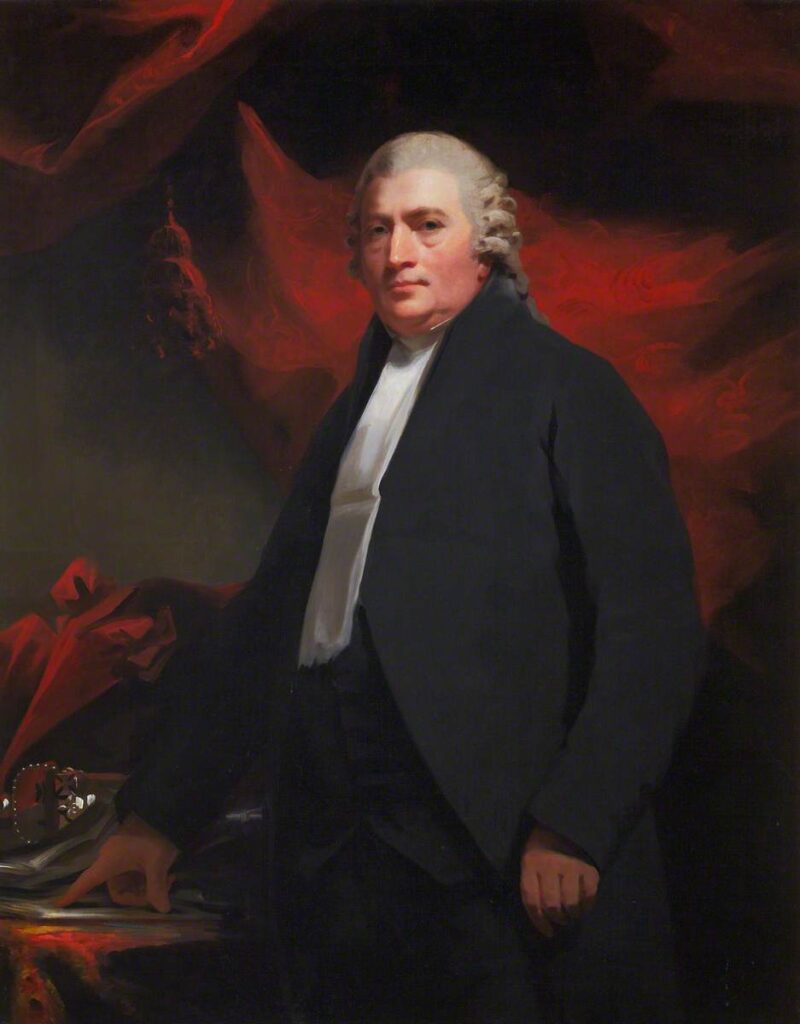
In 1811, Raeburn provided the second painting in the Society’s collection, a portrait of Robert Blair, the Lord President of the Court of Session. This and subsequent commissions by the Society of portraits of leading lawyers from outwith the Society’s membership perhaps represent a certain confidence in the Society’s place within the College of Justice and the wider legal world. Although the portrait is a copy (by Raeburn of Raeburn’s portrait of Robert Blair, which is now in the Indianopolis Art Museum) it is arguably a superior work to the original. It was the first of the Society’s art collection to be photographed – in 1909, in colour!
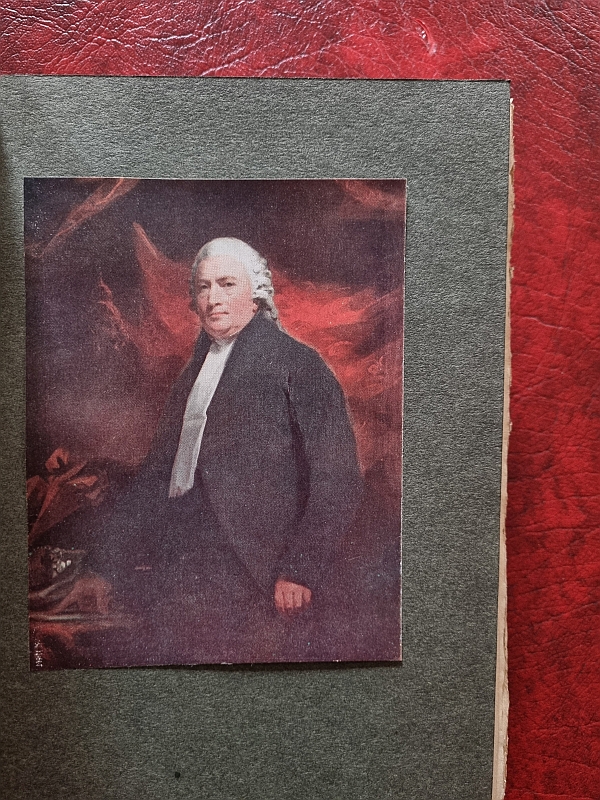
Raeburn’s famous reds did not lend themselves to Victorian orthochromatic photographic emulsions, and when in the mid-1870s Thomas Annan produced his photographic survey of Raeburn’s works, the portrait of Blair was one of several instances where he resorted to photographing prints and engravings rather than the troublesome originals.
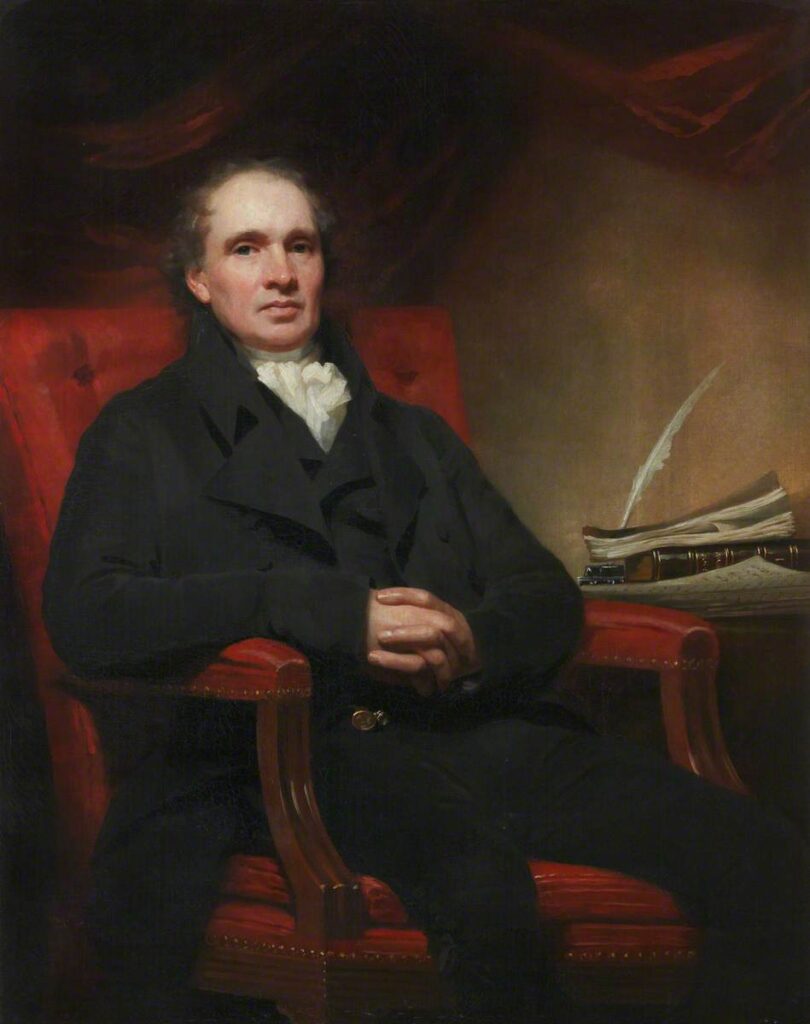
Another of these was the portrait of Baron David Hume, the great reformer of Scotland’s criminal law, commissioned by the Society in 1822. The painting now hanging in the Playfair Lobby is widely considered to be a copy of the portrait of Hume in Parliament Hall, but in error: the Faculty portrait was also commissioned by the WS Society as a gift to Baron Hume whose family later donated it to the Faculty’s collection. The portrait of Hume was the first to be commissioned after the WS Society’s move to the new Signet Library in November 1815, and it is not known where it was initially hung.
The Great Fire and After
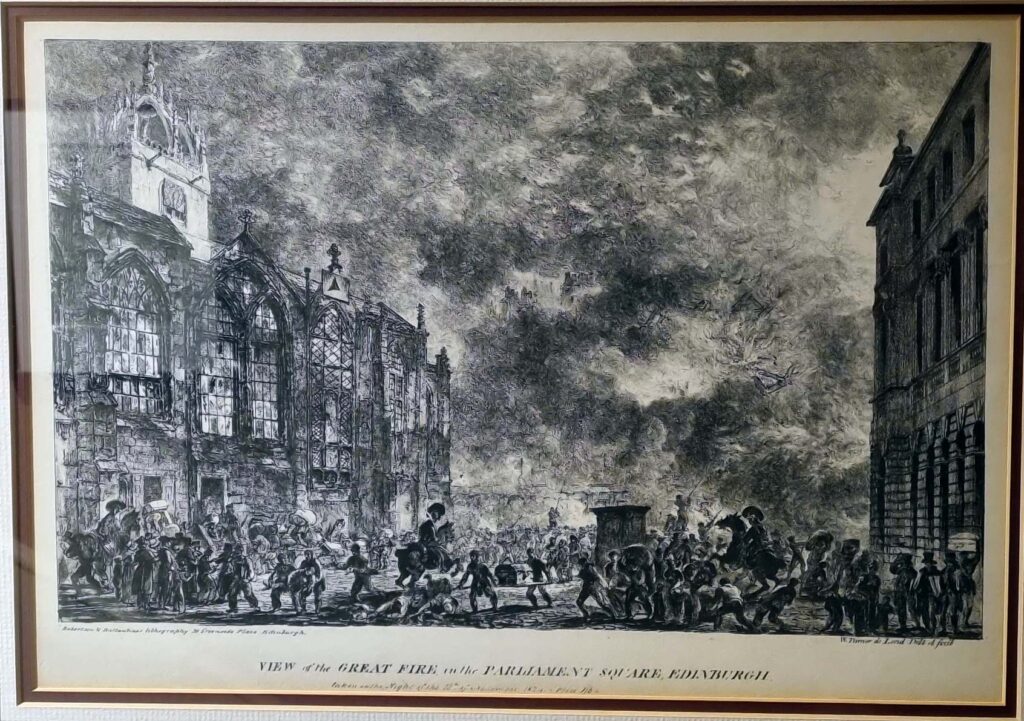
Everything changed with the Great Fire of Edinburgh in November 1824. The Signet Library – then still divided and shared, with the Faculty of Advocates occuping the Upper Hall – narrowly escaped destruction, with the most famous picture of the conflagration being drawn from the building’s eastern door. In response, the Faculty of Advocates built a new library to the south and the WS Society purchased the Upper Hall, taking possession of the entire building for the first time.
They would take over a part of the building that had only recently been reshaped. The original staircase to the Upper Hall had been built by Robert Reid to fit William Stark’s redesign of the building in 1812-13, but this had been thoroughly redesigned and rebuilt by William Playfair in 1819, reshaping the entrance to the Upper Hall and redesigning the Lobby into its current form. In 1833 WS Society architect William Burn (Playfair’s energetic rival and to some extent enemy) was commissioned to tear out Playfair’s staircase and replace it with the Grand Staircase of today.
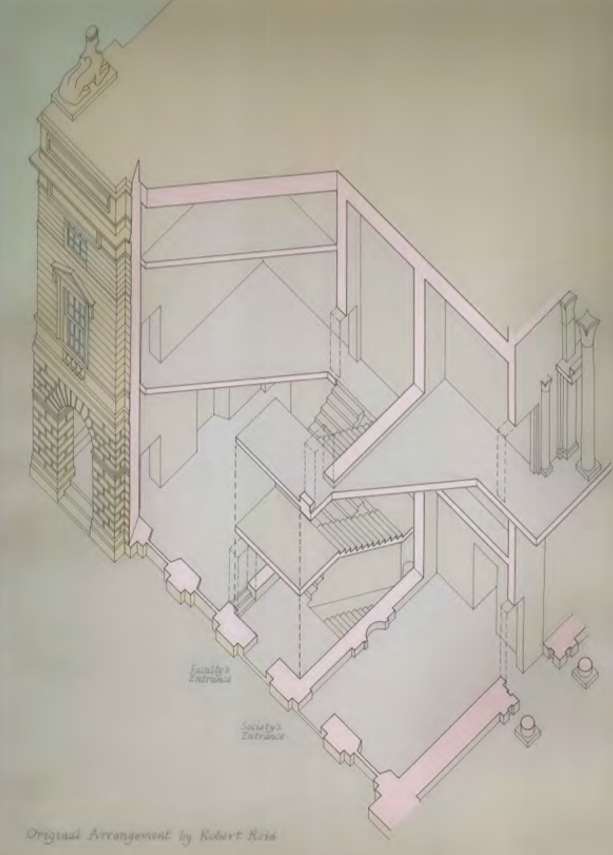
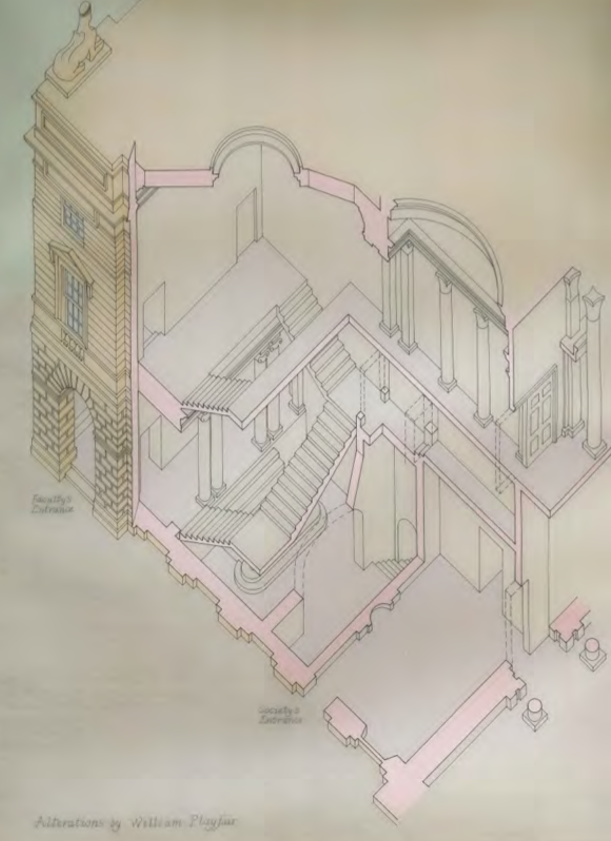
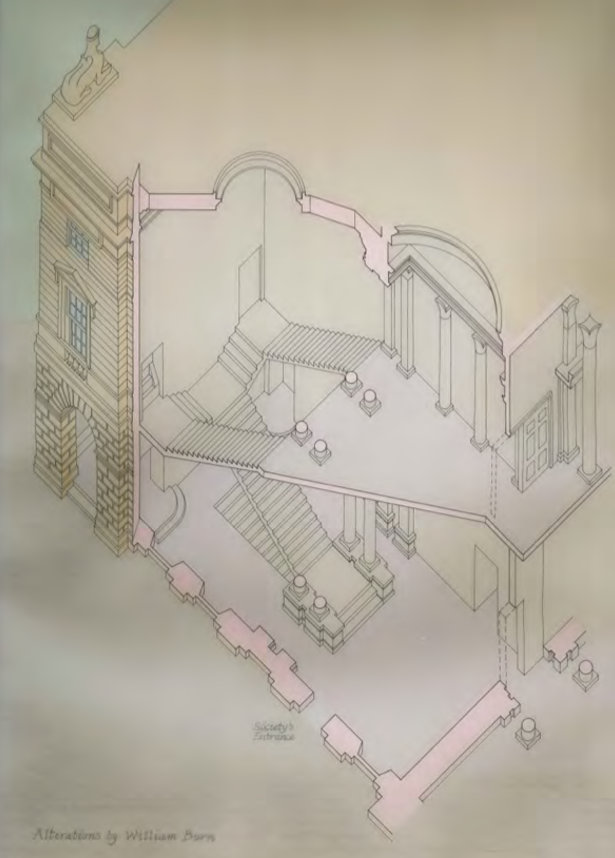
The development of the staircase and lobby. Stark 1813 (Left); Playfair 1819 (Centre); William Burn 1833 (Right)
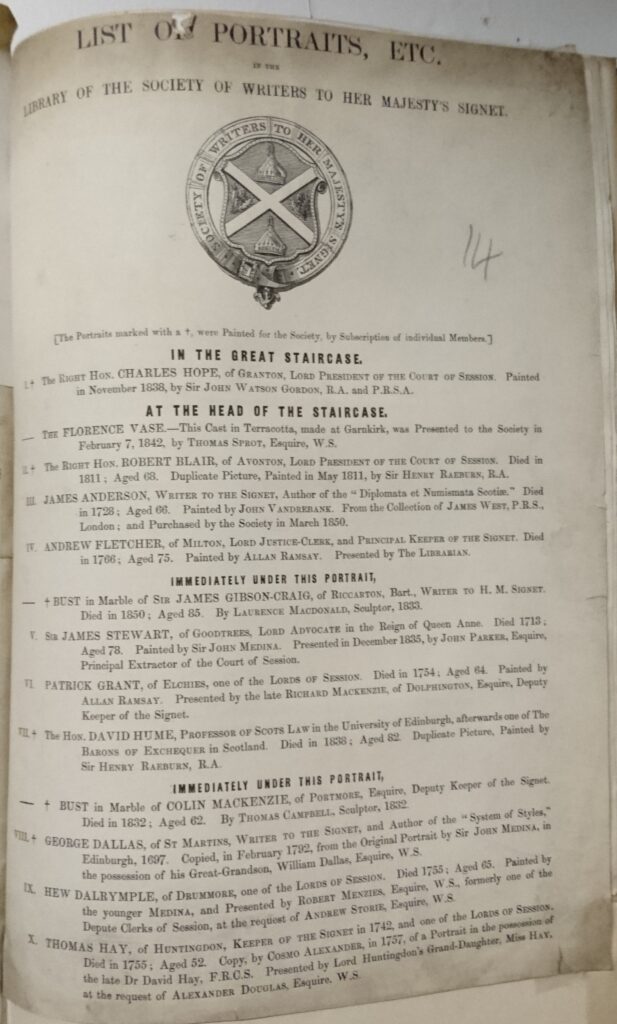
With this completed, the WS Society could set about moving books into the Upper Hall, but it was also presented with a vast new wall space to fill. Between 1833 and 1838, a flurry of gifts and commissions – six portraits and a bust – would ensure that the space would be inhabited in spectacular style.
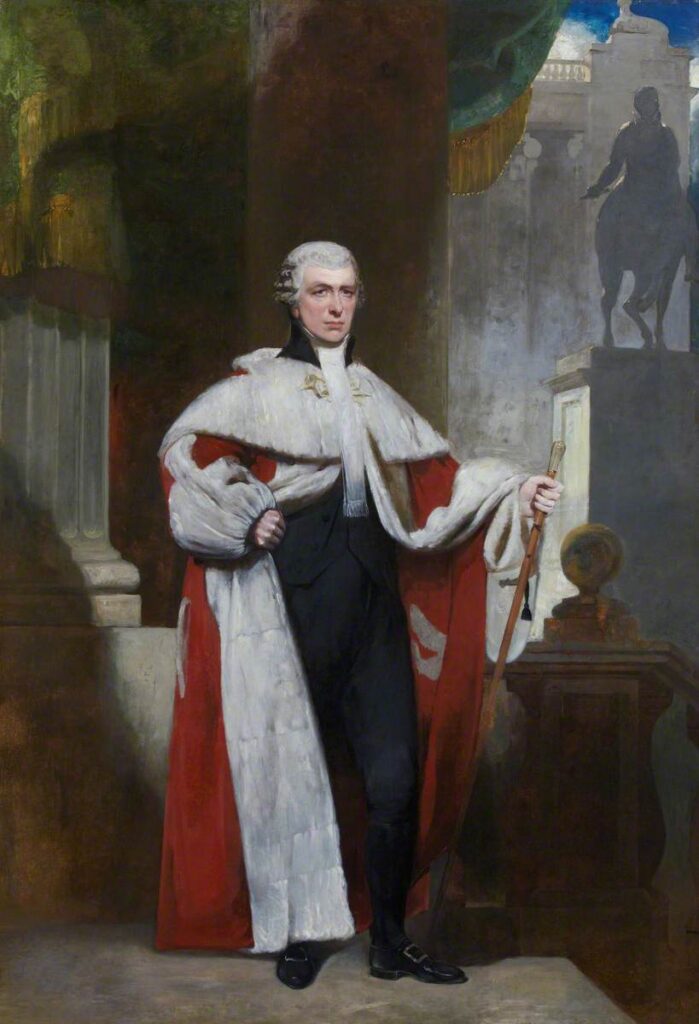
With the passing of Sir Henry Raeburn in 1823, the WS Society turned to Sir John Watson Gordon for its future commissions. The first of these – and by far the most spectacular – was the last of this sequence, the vast portrait of Sir Charles Hope, painted in 1838. Too large to move, the picture is believed to have been the only one to remain in the Library during the war crisis of 1939-1945.
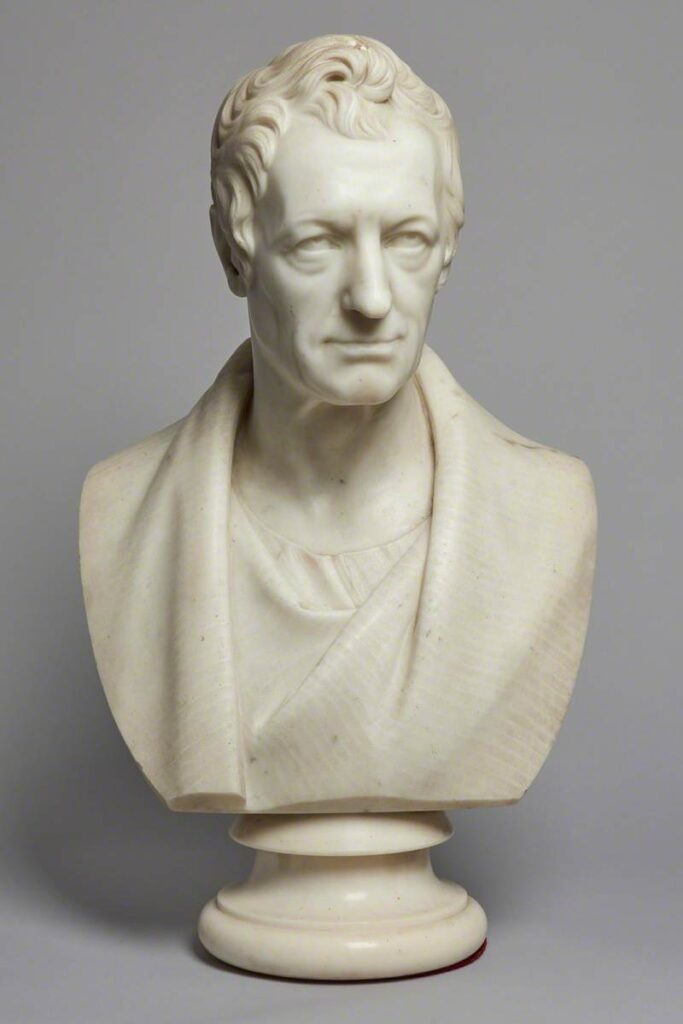
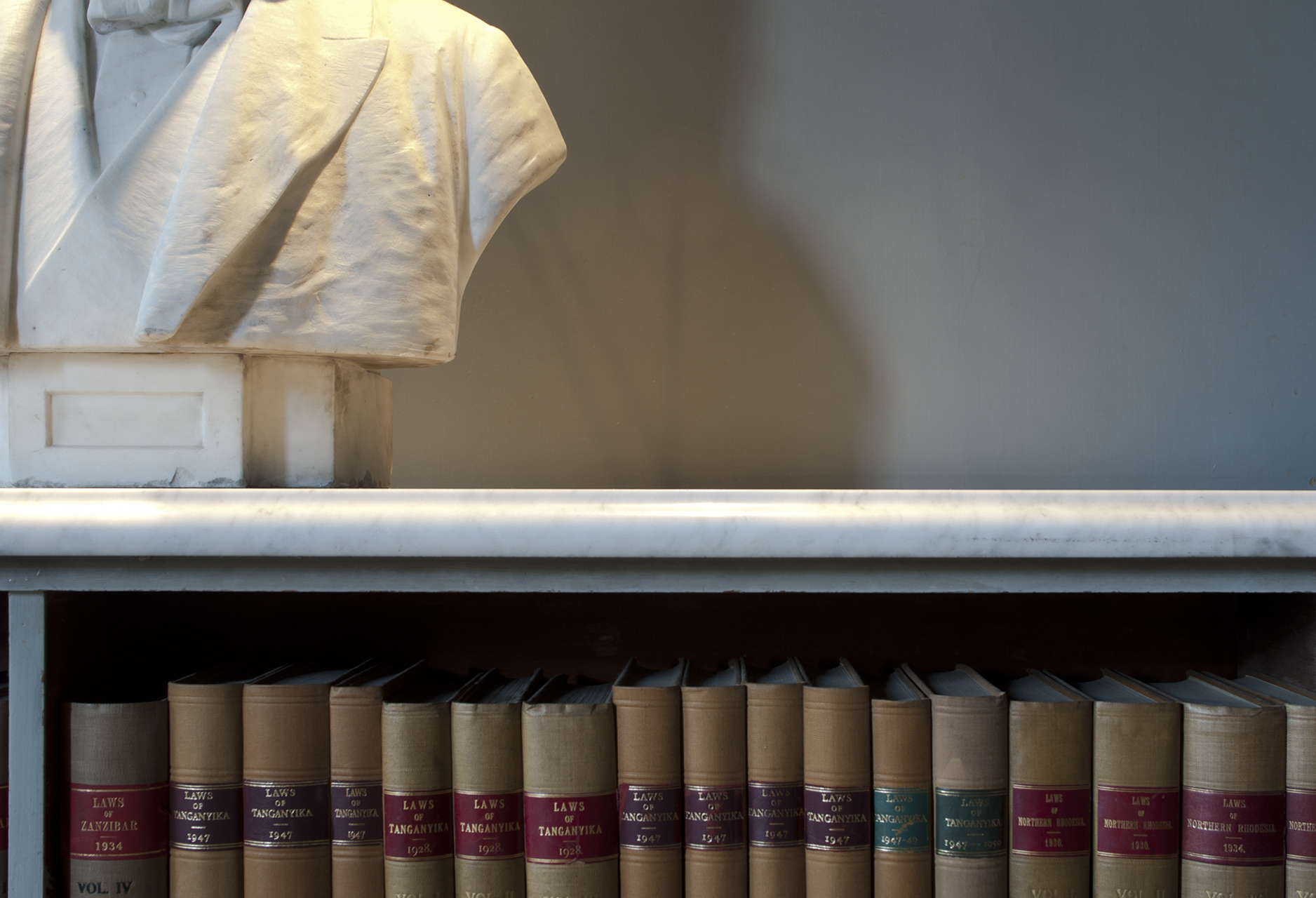
Two of the artworks on the Lobby by 1838 were marble busts of Writers to the Signet. The first of these, depicting Deputy Keeper Colin Mackenzie of Portmore, was commissioned in 1829 from the great sculptor Thomas Campbell. The other, a bust of John Gibson Craig WS of Riccarton, sculpted by Laurence MacDonald in 1833, is no longer at the Library. It is somewhat forgotten now that sculptures were a popular alternative to oil paintings in portraiture, both for their longevity and for the gesture they provided at the artistic traditions of the ancient world. In 1842, the Garnkirk (or “Florentine”) vase joined the busts on the Lobby, a donation by Thomas Sprot WS whose family were industrialists in Garnkirk and beneficiaries of the recently constructed railway between Garnkirk and Glasgow. The mystery as to the origin of the design of the Urn was solved as late as 2019 when it was revealed to be a copy of the Graeco-Roman Medici Vase at the Uffizi Gallery in Florence.
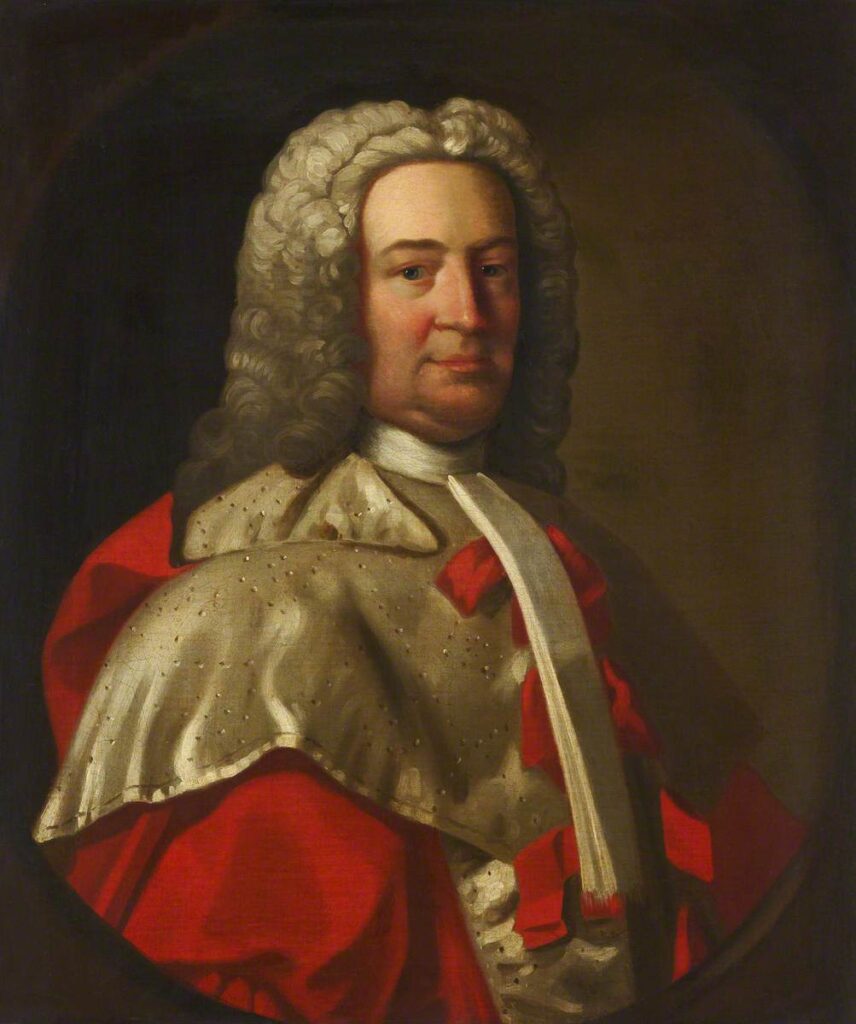
Donations of paintings were a feature of this first period of growth. The portrait of Sir James Steuart of Goodtrees (once attributed to Sir John Medina) was presented in December 1835 by John Parker, Principal Extractor of the Court of Session. The portrait of Andrew Fletcher, Lord Milton – a copy of Allan Ramsay’s portrait of Milton and possibly executed by Ramsay’s studio – was presented by Librarian David Laing, a considerable art collector and connoisseur in his own right and probably the source of many of the early attributions of the Signet Library collection. Laing’s gift was made in 1837 following his appointment to the Society that year as the first office holder from outwith the Society.
The Portrait of James Anderson WS
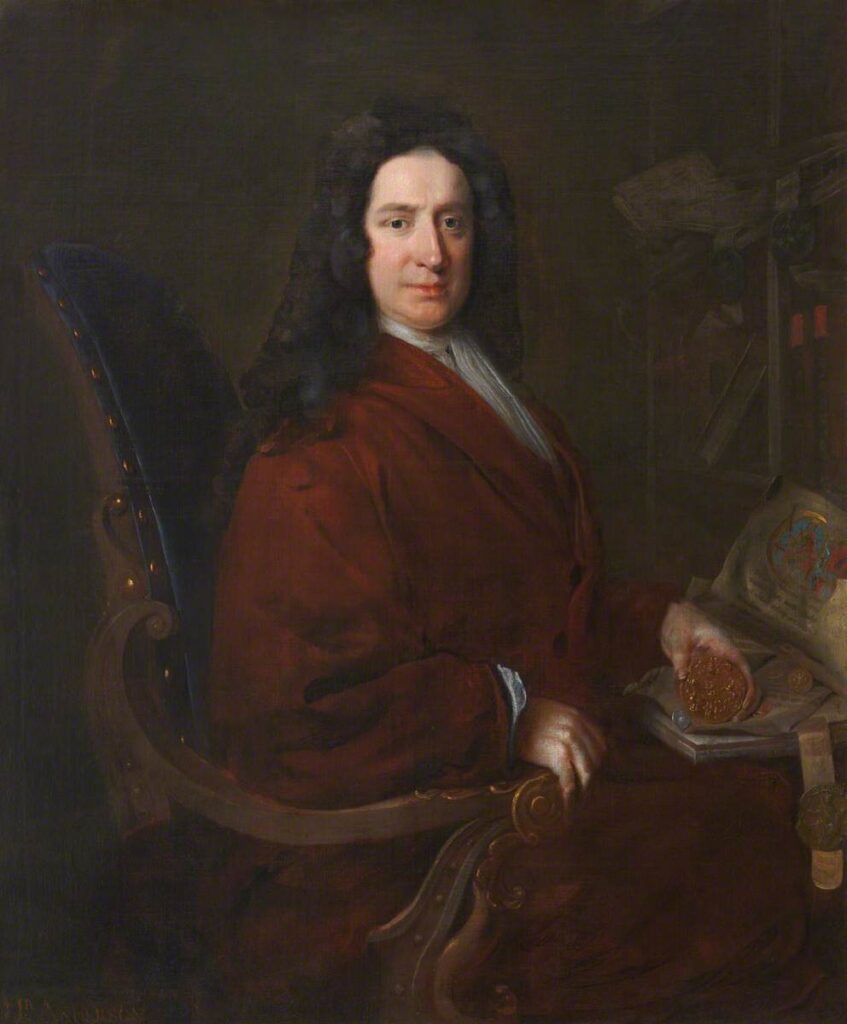
In March 1850, David Laing was the agent of perhaps the most interesting of the early art acquisitions by the WS Society, the portrait of James Anderson WS, one of the Society’s greatest scholars and historians and author of the Diplomata Scotia. Anderson had had his portrait painted c. 1710 as a gift to Robert Harley, Lord Oxford, in the vain hope of securing patronage from Harley for his research and publishing.
Laing alerted the Society to the portrait becoming available and acquired it for £10, attributing the picture – almost certainly erroneously – to John Vandrebank. It is not yet known with whom Laing brokered the purchase, and he was not forthcoming on the matter.
What is known is that the painting remained with the Earls of Oxford until the Sale of Edward, Earl of Oxford in March 1742, under the description “Mr. Anderson the famous Scots Antiquarian”. The sale catalogue attributed the portrait to “Mr. Hill”, presumably the Georgian portrait artist Thomas Hill. It is notable that Hill painted Humphrey Wanley, Harley’s Librarian, twice, the first time in 1711, and that this first portrait is the same size – one unusual for its format – as Anderson’s. One of the two Wanley portraits was in the same 1742 auction. The 1711 Wanley portrait is captioned with Wanley’s name; the style of the caption – in gilt capitals – is nearly identical to the caption on Anderson’s portrait.
The painting next surfaces on March 31st 1773, at the Sale of James West, the late President of the Royal Society of London, where it shared Lot 3 with a portrait of “Mr. Lownds” (believed to be the Kneller portrait of William Lowndes (1652-1724), Secretary to the Treasury. It is intriguing to see Anderson’s portrait paired at the sale with a picture by Sir Godfrey Kneller, as, although Thomas Hill is most likely to have been responsible for Anderson’s portrait, it may indeed have been Kneller’s studio that Anderson resorted to in order to obtain a portrait of himself for Harley in 1710).
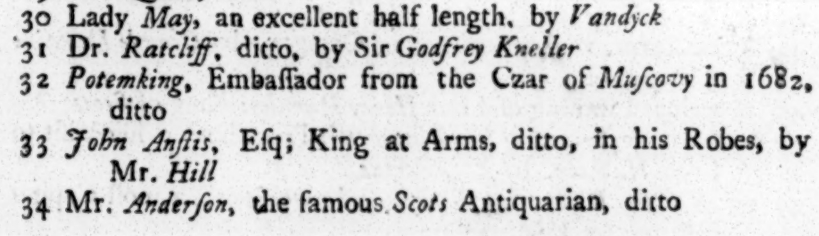
A sketch of “Anderson the Scotch Historian” appears as lot 65 in Thomas Thane’s sale of miniatures and drawings on 19th June 1846 but interesting as this is it is unlikely to be the oil portrait and its whereabouts between 1773 and 1850 remain a mystery. One possible source for Laing’s acquisition of Anderson’s portrait is an Edinburgh sale by dealer David Hay on 23rd February of “pictures of [a] gentleman in the country” and it may or may not be notable in that respect that the great advocate and writer Francis Jeffrey died in January 1850.
We have identified Thomas Hill (the most likely) and Sir Godfrey Kneller (the first reserve) as possible artists for the Anderson portrait, but there is one further candidate. A letter to Anderson by the young Scottish artist John Alexander (1686-1766) dated 12 September 1710, when Alexander was briefly working in London, discusses a copy Alexander was engaged in making for Anderson of a portrait of Mary Queen of Scots. Alexander’s letter also mentions “your picture” which he has left with Anderson’s sister Mary. Alexander would leave soon after for an apprenticeship in Italy, where he would make his artistic fortune painting members of the Jacobite exile community. Alexander’s letter is transcribed in Notes and Queries Series 2 no. 5 p.272 1858 (i.e. almost a decade after the acquisition of Anderson’s portrait by the WS).