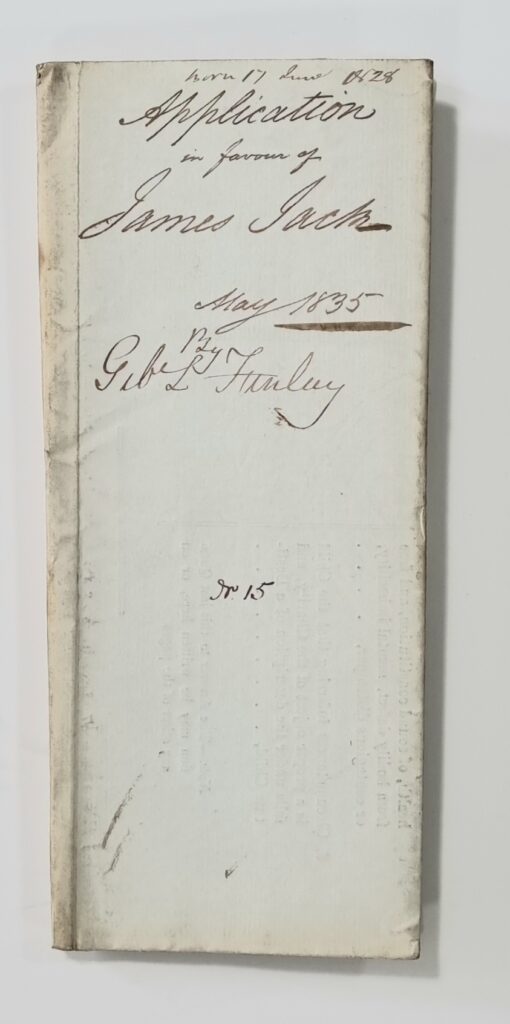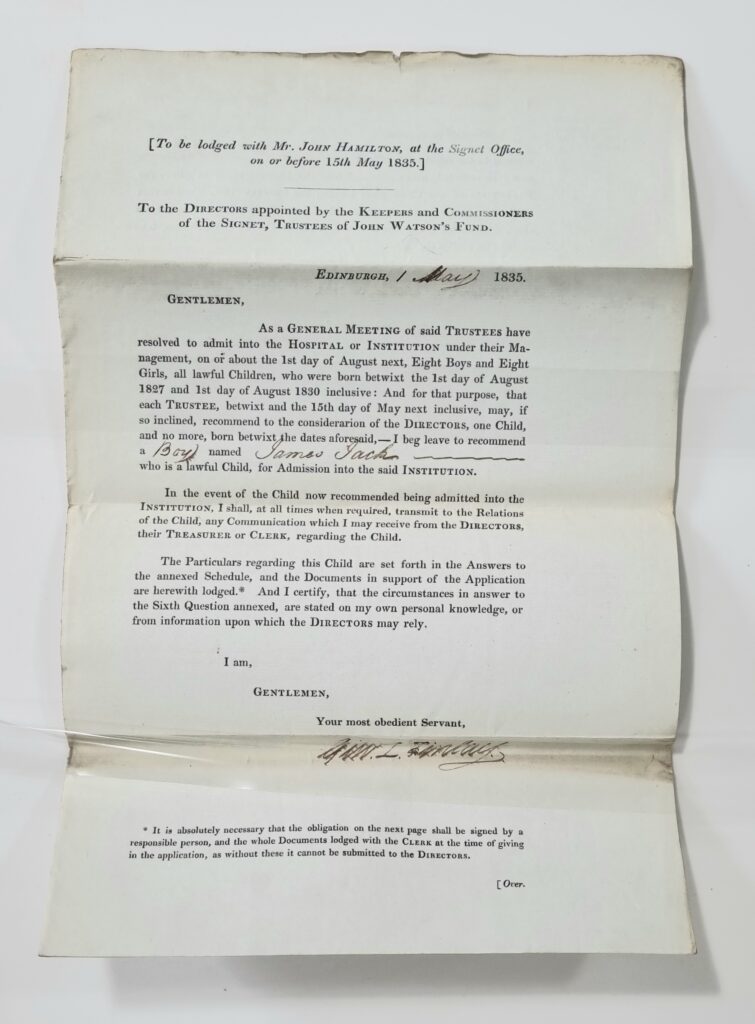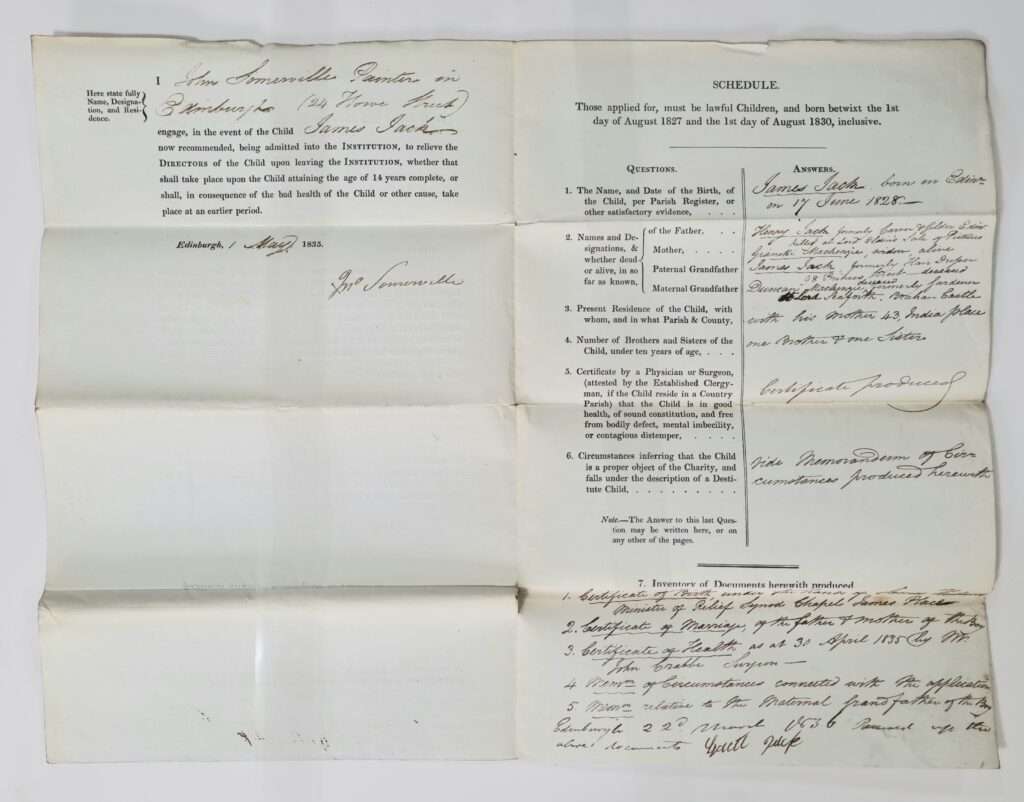

James Jack was born on 17 June 1828. His father, Henry Jack, a carver and gilder, died when the floor collapsed during the auction of Lord Eldin’s sale of pictures.
The Caledonian Mercury reported on the accident on 18 March 1833, by noted only one fatality, that of Alexander Smith, Esq. :
CALAMITOUS ACCIDENT AT THE SALE OF LORD ELDIN’S PICTURES.
A dreadful accident occurred at the sale of the Eldin Collection of Pictures on Saturday…one excellent individual and most estimable citizen has lost his life, having survived the accident only a very few minutes, and many persons are hurt, some of them, it is to be feared, seriously….
About twenty minutes or half an hour past two o’clock on Saturday, while Mr Winstanley was in the act of disposing of an exquisite Teniers…a crash was heard which evidently announced some accident, but at the instant no one was aware whence it proceeded, or had the least idea of the extent of the calamity of which it was a forerunner. It sounded as if some shelving had given way, or as if some pictures had been overturned; but it was only when a dense cloud of dust arose, accompanied with the wild shrieks and screams of the sufferers, that the fearful extent of the calamity was understood, and it became distinctly known that a portion of the floor had given way….In a few moments of time, from eighty to a hundred persons, ladies as well as gentlemen, were precipitated in one mass, amidst broken joists, bindings, lath, plaster, pictures, furniture, into an apartment immediately below, filled with china and articles of vertù; and considering the circumstances of the accident itself, the height of the fall, the dangerous nature of the materials in the lower apartment, and the crowed mass of human beings suddenly thrown into it, many of them headmost, it seems truly astonishing that so few fatal or serious casualties occurred.
The Caledonian Mercury appealed for funds to support Jack’s family on 8 April 1833:
APPEAL OT THE CHARITABLE AND HUMANE. – We have already had occasion to inform our readers that the late lamented Alexander Smith, Esq. was not the only victim of the sudden catastrophe which occurred at the sale of the Eldin Collection of Paintings, and that Henry Jack, a journeyman carver and gilder…has also died in consequence of the injuries he received on that occasion, leaving a widow enceinte, and five children in a state of complete destitution. But some additional circumstances have since been mentioned to us, which render his case particularly distressing….The condition of these helpless orphans is indeed truly deplorable. The death of the father having been followed by the premature accouchment of the mother, which, again, has been attended with the circumstances of a truly heart-rending description. Jack, we understand, was an industrious, honest, and steady man; and his family, besides their misfortunes, are, from their sobriety and good conduct, most deserving objects of charity. Subscriptions have already been opened in their favour, and something obtained for their relief; but the contributions already made are of small amount.
The Inverness Courier provided more details about Jack’s death on 10 April 1833:
Amongst those severely wounded was Henry Jack, carver and gilder. This young man, from his having a knowledge of pictures, had been employed by several persons to bid on their account, and, having fallen along with others, a splinter of the broken wood entered his head, which was immediately extracted by Dr Hay.
For some days it was thought he was likely to recover. On Sabbath, the 24th, however, he was attacked by erysipelas, a common occurrence after injuries of the scalp….The disease was attended by high fever and delirium, and we regret to say, Jack died on Monday morning at his house, 30, Jamaica Street, after suffering the most excruciating agony. He has left a widow and five infant children, the eldest only nine years of age, in a most destitute situation. He was a young man of excellent character and good abilities; but for two years past, owing to the stagnation of business, has been only employed occasionally.
But the time of Jack’s application and admission in 1835 only two of his young siblings remained.
Unfortunately, his name is a common one. He may have become a soldier, a coal miner, or a miller. He may have left Scotland – James Jacks born in the right year can be found across the world.
application